McKinsey Solve Game Guide 2026 (McKinsey Digital Assessment)
Estimated Reading Time: 16 minutes
Key Insights:
What It Is: The McKinsey Solve Game (formerly the McKinsey Problem Solving Test) is an interactive & gamified, simulation-based assessment that tests candidates’ cognitive abilities, such as: critical thinking, decision making, systems thinking, and situational awareness.
What It’s Testing For: Unlike traditional business knowledge exams, Solve measures how you think, not what you know. McKinsey uses it to evaluate raw problem-solving ability and scale recruiting efforts in a bias-reduced way, often before first-round interviews.
How to Prepare: Forget cheat codes & "how to" material. Each game is unique and decision processes are tracked. Focus instead on building strong casing skills, managing time effectively, analyzing complex data, and making logical decisions under pressure. Yes, just like in a real consulting case.
The McKinsey Solve Game (aka: McKinsey Digital Assessment) is a game that assesses your ability to solve business problems using technology, and can be a part of McKinsey's screening process before you are invited to interview with the firm. The McKinsey Solve Game - referred to by McKinsey simply as "Solve" - was designed to replace the McKinsey Problem Solving Test (PST), which was a more traditional GMAT-style test.
However, unlike the PST, which focused on general business knowledge and problem-solving skills with no particular industry or functional focus, McKinsey Solve is built to test your cognitive abilities and problem solving skills. So, even though it seems counterintuitive, business acumen isn't as important to ace the McKinsey Solve Game.
It is important to note that memorizing McKinsey Digital Assessment prep materials that show you how to "win" the game or "hack" the Imbellus test may actually lead you astray. This isn't a test - it's a video game that contains multiple simulations, and there are multiple ways to "win." Rather than blindly following a process that any 3rd party recommends, it is more important to focus on building the skills that McKinsey is testing for.
As a result, developing skills that the case interview tests for will also help you pass the McKinsey Solve Game.
How Does McKinsey Solve Game Work?
The McKinsey Solve Game - formerly known as the "McKinsey Problem Solving Game" is an interactive gamified assessment that is used to help the firm understand how to develop and retain top talent. It was created by Imbellus, a company that creates simulation-based assessments. To put it in plain language - the assessment is a video game that places you in one of several ecosystems, and it's your job to keep the ecosystem alive in the midst of challenges that are thrown your way (including predators!)
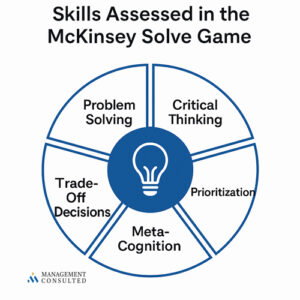
The game measures your cognitive abilities, including your ability to problem solve, think critically, make trade-offs, sense of prioritization, and your meta-cognition. It is not a business knowledge test, nor does it test technical skills beyond basic computer skills.
You can take the exam at any time at home online within 1 week of receiving the link. You will be tasked with navigating eithertwo distinct games within 65 minutes or three distinct games within 80 minutes (the third game may be experimental), and there will be a timer displayed on the test. One of the challenges of passing the McKinsey Solve Game is time management - you must complete your games within the allotted time!
Candidates typically receive their results within two weeks of completing the assessment. If candidates fail the assessment, some have reported that they can not re-take it within two years. Others report that their ban is one year. Either way, you’ll want to make sure and do well on the test!
However, your performance in the McKinsey Problem Solving Game is not the only data point McKinsey considers when looking at your profile. There are many other factors (the strength of your resume, your ability to gain a referral, timing, etc.) in play. In fact, we've heard of folks bombing Solve but still receiving an interview invite.
The assessment can currently be taken in several languages including:
English
Spanish
Japanese
Portuguese
Other languages may be in development. Check with your recruiter to determine if your native tongue is supported.
The Purpose of the McKinsey Solve Game
The assessment allows the firm to scale their recruiting efforts without socio-economic biases. Before this assessment, candidates with means to acquire paid coaching or prep materials were said to have an advantage over those who couldn't afford it.
McKinsey partnered with Imbellus to create the Solve Game to overcome these issues. Perhaps more importantly to the firm, the Solve Game allows them to expand the top of their recruiting funnel without committing more human capital to the screening and interview process.
Does Solve Require Business Knowledge Like the PST?
The McKinsey Solve Game does not require knowledge of business or management. So this assessment shares that characteristic, the same as the old McKinsey Problem Solving Test did. The game is designed to test the way you think and your problem-solving abilities. Remember, McKinsey isn't hiring new consultants for their business acumen, given the stage of career that they're in. McKinsey is assessing the way you think and problem solve. If you are able to analyze data and make logical, systems-based decisions, then you can do well on the McKinsey Solve Game.
McKinsey Solve Game Scenarios
McKinsey Solve is made up of multiple games or scenarios. To date, candidates have reported seven different scenarios. (Yet, McKinsey does switch up scenarios, sunsetting some and promoting others.) Of those, three seem to be more consistently used, three are more sparingly used, and a newly reported Sustainability scenario appears to potentially be experimental (McKinsey has reportedly been soliciting candidate feedback on it).
The three scenarios that are most commonly seen are:
Ecosystem Management (Most common)
Redrock Study
Sea Wolf
The other three scenarios that candidates have encountered are:
Disease Management
Disaster Management
Migration Management
Note: The Plant Defense scenario seems to no longer be used. A newly reported scenario, Sustainability, is described below (Scenario 7). It may be experimental, as McKinsey has been collecting candidate feedback on it.
Game Details
You do not need special/previous knowledge to complete any of the scenarios/games.
Directions are given before each game.
A candidate has between 65-80 minutes to complete all games (65 minutes for two games, 80 minutes if a third, potentially experimental, game is included).
Once a game is started, it cannot be paused.
Breaks are allowed in between games.
Games change every time they are played. Beware: this means that you cannot solve a game exactly like how somebody else did it.
Managing your time is critical.
Remember that the assessment is gamified, so it feels like a video game, but in actuality the game is testing your cognitive skills. The final result is important, but not the only metric the firm cares about. Your decision-making from start to finish is being examined.
Scenario 1: Ecosystem Management
In this scenario, you will be asked to solve a problem around Ecosystem Management. The context is either a coral reef or a mountain ridge.
Ecosystem Management Goal:
Sustainability through creating an adequate food chain for the species and the chosen location.
Scenario Details:
Species are divided into categories.
Understand the needs of the species that are in the ecosystem.
Choose 8 species to focus on, including some from each category.
The variables that affect your species choice are:
Food Sources
Predators or Herbivores
Calories Provided
Calories Needed
Preferred Environment
Once the species are defined, determine a location that is best for those species given a set of variables.
The variables that affect your location choice are:
Location is represented by a marker that can be dragged around on the scenario map.
Moving your cursor over these markers will allow you to see the attributes of each location.
Assess which attributes would be best for the set of your chosen species.
Mountain Ridge Context Variables:
Sunlight
Precipitation
Altitude
Cloud Height
pH of Soil
Wind Speed
Moisture
Coral Reef Context Variables:
Temperature
Depth
Current
Clarity
Salt Content
Dissolved Oxygen
Wind Speed
Scenario 2: Redrock Study
In this scenario, a candidate engages in research about animals and answers questions about them.
Redrock Study Goal:
Answering questions correctly based on previously given information.
Scenario Details:
This scenario is divided into four segments: Investigate, Analysis, Report, and Case. The total time allotted is 35 minutes, and many candidates find it difficult to finish all four segments in that window.
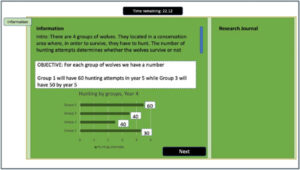
The first segment, Investigate, is focused on research. You'll be given an objective, and based on it, you'll collect information on the right-hand side of the screen to use in the later segments.
You are given a prompt/objective, and information to sift through.
The information could be in the form of:
Graphs
Text
Numbers
Tables
You have to determine what information is important, and what isn’t.
You are provided a notes area where you can save pieces of information.
The second segment, Analysis, requires you to answer 3-4 math questions using the information you collected. Each question may involve two separate parts, often tied to two different groups of animals. A calculator is embedded directly in this segment.
The third segment, Report, has two parts: a written part where you answer 5 questions based on your Analysis findings, and a visual part where you choose a graph and use it to represent your results.
The fourth segment, Case, requires you to answer about 6 questions unrelated to the analysis performed earlier in this scenario. It involves a case study component.
You may be asked to calculate numbers, but a calculator will be provided.
Scenario 3: Sea Wolf
In this scenario, you will be asked to design treatments for contaminated ocean sites using microbes to clean up pollution.
Sea Wolf Goal:
Create effective treatments for three ocean sites by selecting microbes that match site characteristics and reduce pollution.
Scenario Details:
This scenario involves treating three contaminated ocean sites, each with unique environmental conditions.
For each site, you will first categorize a set of 10 microbes before narrowing them down according to the game's rules.
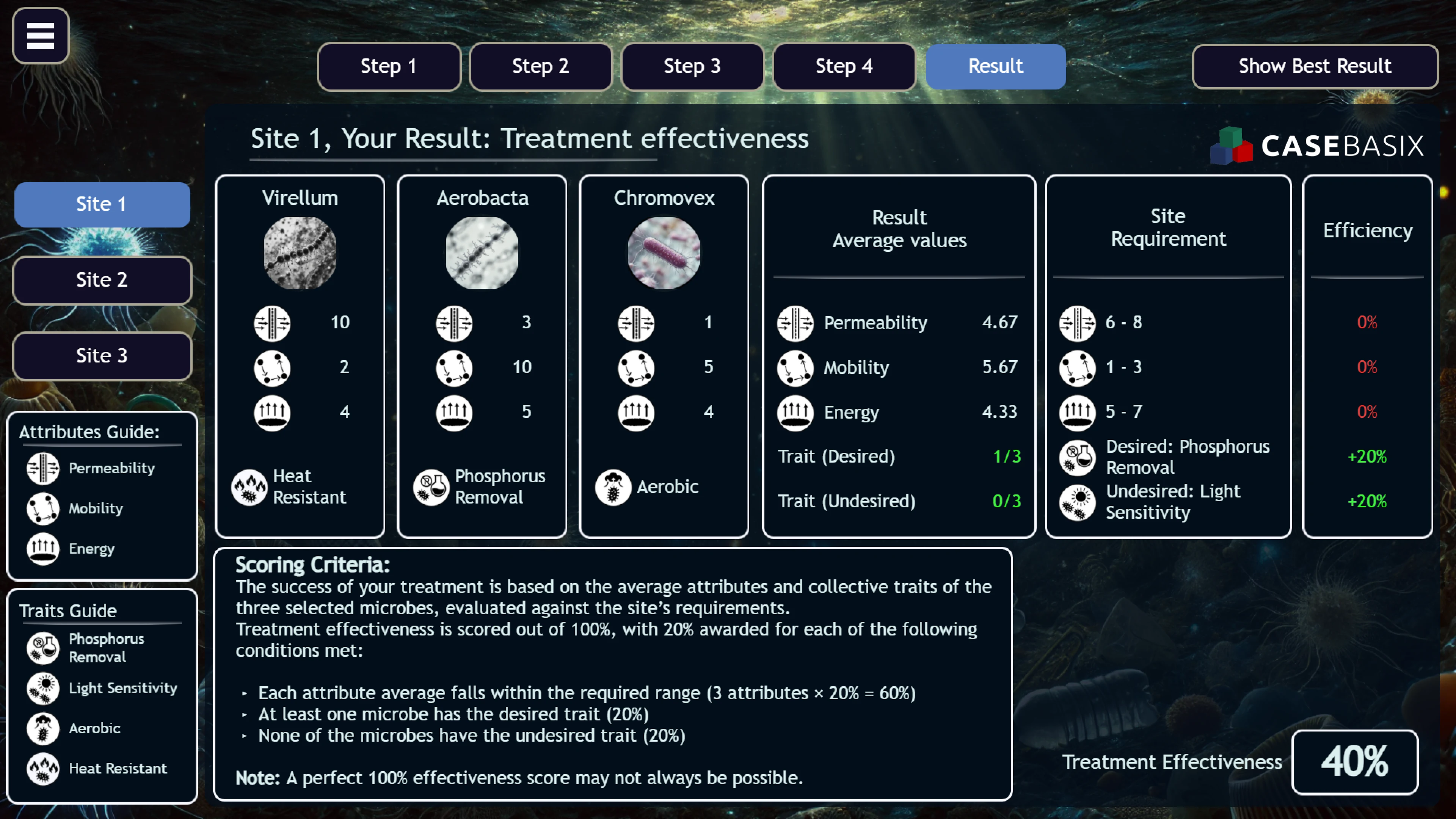
For each site, you will build a treatment consisting of 3 microbes selected through a step-by-step process. There are up to 5 steps per site, and 14 total steps across all three sites (roughly 2 minutes per step on average):
Step 1: Select 2 out of 7 microbe characteristics.
Step 2: Categorize the 10 microbes.
Step 3: Narrow your choice down to 4 microbes.
Step 4: Make a final selection of 3 microbes.
Step 5 (Sites 1 & 2 only): Confirm the microbes allocated to that site.
The variables that affect your microbe selection are:
Microbe Characteristics
Site-Specific Requirements
Pollution Type and Level
Environmental Conditions
Treatment Effectiveness
Microbe Compatibility
Each site provides specific attributes and traits through sticky notes on your screen.
The variables that affect site treatment success are:
Site conditions are displayed through interactive interface elements.
Moving through the selection process allows you to analyze microbe suitability.
Assess which microbe combinations would be most effective for each site's unique conditions.
Ocean Site Variables:
Permeability
Contamination Level
Water Temperature
Salinity
Oxygen Levels
pH Levels
Pollution Type
Steps 1-4 repeat for every site, requiring you to match microbe characteristics as closely as possible to site requirements. Step 5 (confirming the site's allocated microbes) only appears for Sites 1 and 2, not Site 3.
Treatment effectiveness depends on how well the selected microbes' attributes align with the specific needs of each contaminated site.
Scenario 4: Disease Management
In this scenario of the McKinsey Solve Game, animals acquire a disease and you must identify which may be affected next, and try to stop the spread.
Disease Management Goal:
Define which animals might be infected next and understand how the disease is being transmitted.
Scenario Details:
This scenario does not have turns, but rather a timer at the top of the screen, indicating how much time has passed.
There are two main stages in this scenario.
The first requires you to identify and understand what changed, as compared to the past.
The type, the effects, etc.
The second stage requires you to determine which animals may be affected next.
A key to this scenario is to understand what connection the infected animals have, and try to determine which animals might be affected next.
Animal species information that could affect game play:
Name
Age
Weight
Temperature
Altitude
Time Periods:
There are 3 total time periods
The first 2 time periods should be used to analyze and determine your course of action.
The third time period is where you see how well your plan played out.
Scenario 5: Disaster Management
In this scenario, a disaster hits an ecosystem and you must manage and mitigate the effects.
Disaster Management Goal:
Define the disaster and work to save as many of the affected animals as possible by moving them to a safer location.
Scenario Details:
This scenario does not have turns, but rather a timer at the top of the screen, indicating how much time has passed.
There are two main stages in this scenario.
The first requires you to identify and understand the disaster
The type, the effects, etc.
The second stage requires you to find a place to move the animals to, where they could better survive the disaster.
Elements of the disaster determine the type.
The types of disasters include tsunamis and volcanic eruptions.
Additional criteria will be similar to that of the Ecosystem Management scenario.
Temperature, atmospheric pressure, rainfall, etc.
The best area to move the animals to will depend on the ability to create a sustainable food chain.
The presence of plants or predators are main components of suitability.
Scenario 6: Migration Management
In this scenario, you help animals migrate from one location to another.
Migration Management Goal:
Define the location that animals should move to and help get as many animals to that location as possible.
Scenario Details:
This scenario is turn-based. Each turn corresponds to a move on the map. The game progresses through multiple maps, each getting progressively more difficult.
Each map has a starting point and an endpoint, connected by defined path(s). Each location has specific resources associated with it.
To start with you’ll only have a few resources like:
Water
Flowers
Apples
Nuts
Your resources increase as you progress.
If you make a move, but don’t have sufficient resources, then you’ll lose animals in that turn.
You won’t have all the information you need about resources before you make a move.
You’ll want to reach the endpoint with as many animals alive as possible.
Scenario 7: Sustainability (New / Potentially Experimental)
In this scenario, you're given a passage of information on a sustainability-related topic and asked questions to test your reading comprehension. Some candidates have received this as their third game in place of one of the three more established scenarios, and McKinsey appears to be collecting candidate feedback on it, which suggests it may still be experimental.
Sustainability Goal:
Read the passage provided and select the response that makes the most logical sense based on what you've read.
Scenario Details:
You are given a paragraph of information on a sustainability topic.
Questions are presented in multiple-choice format; you pick the response that makes the most sense given the passage.
Some questions may be True/False rather than multiple-choice.
Because McKinsey has reportedly solicited candidate feedback specifically on this scenario, it's possible this game is experimental and not yet weighted the same as the other scenarios.
What is McKinsey Solve Testing For?
The McKinsey Solve Game is testing for five key cognitive abilities:
Critical Thinking
The ability to form a rational decision from a set of facts without simply taking a circumstance at face value. You must understand the context and attribute value to different factors accordingly.
Decision Making
The ability to select the best course of action among several options with limited time and information.
Meta-Cognition
The ability to use strategies to make learning information and solving problems easier (i.e., testing hypotheses, taking notes). In large part, understanding how you think.
Situational Awareness
The ability to determine the relationships between different factors and to project the outcome of a scenario.
Systems Thinking
The ability to understand cause & effect relationships involving several factors and feedback loops (i.e., anticipating several orders of consequence).
Tips On How To Pass McKinsey Problem Solving Game
Of course the natural question candidates want to know is "how to pass McKinsey problem solving game"? We've told you that just following 3rd party "how to win the game" type of resources aren't the best choice. The game cares much more about testing your ability to think strategically and analytically, so focusing on solid casing techniques is more beneficial than memorizing answers. Additionally, with the firms "sussing out" and frowning on AI assisted answers, focusing on developing your problem solving mind is certainly the way to go. McKinsey even says that if flags are raised about your answers, you could be contacted to explain your logic. This shows that they take it seriously and cheating will not help you. To that end, we've put together some simple tips that will help in your quest to conquer Solve.
Tips For Success Over Solve:
Do Not Use Exact Solutions From Past Candidates
The McKinsey Solve Game provides a unique scenario for each test taker. Therefore, the situation you encounter could be completely different from the one that other candidates see. (Even if it looks the same.) Use your critical thinking skills here! If McKinsey is going to pay millions of dollars to develop a game to assess candidates, don't you think they would account for re-using answers? We believe they have and it's not worth risking your one shot to re-use solutions from past candidates.
Time Is Key, Manage It Well
In order to pass McKinsey Solve, you must complete all of the tasks within the allotted time limits. If you don’t finish all of the tasks, then you will fail the test. Don’t spend too much time on one section!
Understand The Directions!
It may seem simple, but reading the directions (not assuming) and gaining a thorough understanding is key to accomplishing the tasks. The good news is that the time you spend in the tutorials and reading the directions doesn’t count against your time limits. So, ensure you understand the directions and rules before you begin!
Analyze The Data Given
There will be a lot of data points and variables included in the scenarios. Some of this data is a red herring. You must prioritize the pieces of information that are actually important. This is similar to a case interview. Keep the end in mind and make sure your logic makes sense with the overall goal. Assess the data well, and add it to your notes for later use. It may not be available to you once you change screens.
Decide With Incomplete Data
A point that McKinsey emphasizes in their overview of the assessment is that you’ll have to make decisions with incomplete information. The game is designed this way. There is not enough time to vet every option conclusively. Do your best to understand what information is important and make a decision.
Prepare Your Space
Get ready for the assessment by having a quiet place to take the test with reliable internet access. You don’t want to lose connection while taking the test!
Concluding Thoughts
The McKinsey Solve Game is a fascinating new-ish way to measure a candidate’s raw cognitive ability. The tool is still being proven out, but candidates should expect to face some form of the digital exam this recruiting cycle. Other competitors - looking at you Bain and BCG - offer digital assessments of their own. (See additional resources below.)
If you are asked to take the McKinsey Solve Game, we suggest managing your time carefully and being comfortable with making imperfect decisions based upon incomplete information. Since there’s no relevant practice test from McKinsey, take a deep breath and do your best! If you are a good fit for McKinsey, you will likely do well. And if you're not, better to find out now.