Strategic Transformation: How Organizations Redefine Their Future
Estimated Reading Time: 6 minutes
Key Insights:
Comprehensive Reinvention: Strategic transformation redefines an organization’s purpose, structure, and operations to achieve lasting growth and competitiveness.
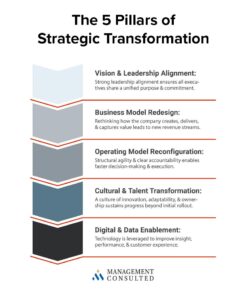
Five Core Pillars: Success relies on vision alignment, business model redesign, operating model reconfiguration, cultural transformation, and digital enablement.
Continuous Journey: Effective transformation is an ongoing process driven by leadership, adaptability, and measurable execution.
In an era defined by disruption, strategic transformation has become the cornerstone of lasting business success. It represents more than a reaction to market changes; it is a proactive reinvention of how a company creates value, operates, and competes. Strategic transformation integrates every level of an organization, from leadership and culture to business models and technology, ensuring all components align toward a single, forward-looking vision. Companies that master transformation not only adapt to new realities but shape them, achieving resilience and long-term advantage in increasingly unpredictable markets.
What Is Strategic Transformation?
Strategic transformation is the deliberate and comprehensive redesign of an organization’s strategy, structure, and capabilities to secure sustainable growth. Unlike operational improvements, which aim to optimize existing systems, strategic transformation reimagines the entire business model. It challenges organizations to ask fundamental questions about what markets they serve, how they deliver value, and why they exist.
Strategic transformation often includes digital change, but the two are not identical. Digital transformation focuses on adopting technology to enhance performance, while strategic transformation uses technology as one tool in a broader effort to reinvent the company’s identity and direction.
Key Drivers of Strategic Transformation
Strategic transformation is typically prompted by a set of powerful forces that make the current way of doing business unsustainable. These forces can arise internally, from leadership ambition, or externally, through market pressure. Understanding these drivers helps organizations anticipate disruption rather than react to it. A clear view of what compels transformation ensures that decisions align with long-term strategic intent rather than short-term fixes that may not endure. The most common drivers of transformation reflect a combination of technology, performance, and opportunity.
Technological Disruption: Advances in artificial intelligence, automation, and analytics are redefining entire industries. Companies that fail to adapt risk falling behind faster-moving competitors.
Market Shifts: Evolving consumer expectations, new entrants, and regulation can quickly make old business models obsolete.
Performance Decline: Stagnating growth or profitability often signals deeper structural issues that require full-scale reinvention.
Strategic Ambition: Entering new industries or markets may demand a complete rethinking of strategy and capabilities.
The Five Pillars of Strategic Transformation
While every organization’s transformation journey is unique, successful transformations consistently share a set of foundational pillars. These pillars represent the interdependent dimensions that define strategic success. Each pillar must be addressed holistically, as progress in one area is limited without the others. Together, they form the blueprint for sustainable and scalable change that reshapes the organization’s competitive position.
Vision and Leadership Alignment: Strong leadership alignment ensures all executives share a unified purpose and commit to necessary trade-offs.
Business Model Redesign: Rethinking how the company creates, delivers, and captures value often leads to new revenue streams.
Operating Model Reconfiguration: Structural agility and clear accountability enable faster decision-making and execution.
Cultural and Talent Transformation: A culture of innovation, adaptability, and ownership sustains progress beyond the initial rollout.
Digital and Data Enablement: Technology is leveraged to improve insight, performance, and customer experience.
The Strategic Transformation Process
Transformation is both an art and a science. It requires a structured process that guides an organization from diagnosis to execution while maintaining flexibility for iteration and learning. This process ensures leaders can translate high-level strategy into measurable results. By breaking the effort into distinct stages, companies can manage complexity, allocate resources effectively, and track progress with clear accountability. The following process represents the key phases that leading firms use to guide their transformation programs from conception to completion.
Assessment and Diagnosis: Evaluate current performance, identify pain points, and benchmark against best practices.
Strategic Blueprinting: Create a detailed roadmap that defines initiatives, owners, and metrics for success.
Execution and Change Management: Implement initiatives with a strong governance model and clear communication.
Measurement and Adaptation: Monitor results, capture lessons learned, and adjust course to sustain impact.
Common Challenges and Failure Points
Despite careful planning, many transformations fail to achieve their intended impact. The reasons are often consistent across industries and geographies. Recognizing these pitfalls early helps leaders build safeguards into their programs. The most common obstacles arise when organizations underestimate the complexity of change or neglect the human element of transformation. True success requires both strategic clarity and emotional intelligence to maintain engagement across the organization during disruption.
Lack of leadership alignment or ownership at the top
Cultural resistance and poor communication about the “why” behind change
Unrealistic expectations and insufficient resourcing
Failure to connect strategic goals to daily execution
Limited measurement and accountability systems
Best Practices for Success
Organizations that successfully complete strategic transformations share several core practices that enable sustained results. These practices ensure momentum, create organizational alignment, and build confidence across teams. They are not one-time activities but ongoing disciplines that maintain focus and resilience as challenges arise. By institutionalizing these habits, companies can embed transformation as a continuous capability rather than a temporary initiative.
Secure CEO and executive team commitment with visible sponsorship
Build a transformation management office to coordinate cross-functional work
Establish clear metrics and track progress transparently
Communicate frequently, celebrating quick wins and lessons learned
Invest in leadership and talent development to reinforce cultural change
Examples of Strategic Transformation
The world’s most successful companies provide powerful lessons in strategic transformation. Their journeys demonstrate how bold vision, disciplined execution, and cultural renewal can turn challenges into opportunity. Each example below highlights how leadership alignment and strategic reinvention reshaped organizational identity, creating lasting value for customers and shareholders alike. These cases also illustrate how transformation is ongoing rather than finite, requiring constant evolution as markets shift.
Apple: Transformed from a niche computer maker into a global leader in digital ecosystems through hardware, software, and service integration.
Microsoft: Shifted from a product licensing model to a cloud-based service organization under Satya Nadella’s cultural and strategic overhaul.
LEGO: Rebounded from near bankruptcy by refocusing on creativity, innovation, and a direct relationship with its customers.
The Role of Consultants in Strategic Transformation
Consultants play a critical role in helping organizations navigate transformation with structure and clarity. They bring external perspective, analytical rigor, and proven methodologies that accelerate progress. Consultants often act as both facilitators and challengers, ensuring that decisions are data-driven and outcomes measurable. Beyond design and planning, they also help organizations build internal capabilities so the transformation remains sustainable after external advisors exit. This partnership often provides the objectivity and accountability that large-scale transformation demands.
Conclusion
Strategic transformation is not a one-time event but an ongoing discipline. It calls for courage, clarity, and the ability to balance short-term execution with long-term ambition. In a world of constant disruption, companies that commit to continuous reinvention will lead rather than follow. They will attract the best talent, capture emerging opportunities, and remain resilient against market shocks. Ultimately, strategic transformation is about redefining what success means and aligning every part of the organization to achieve it.