In this live McKinsey case interview demonstration, former McKinsey Associate Partner and Management Consulted coach, Divya Agarwal, provides a firsthand look at how top consulting firms approach case interviews. This is a unique opportunity to:
- Observe how interviewers evaluate candidates in real time.
- Gain insider tips from a seasoned McKinsey professional.
- Practice alongside the candidate for a hands-on learning experience.
Whether you’re preparing for upcoming interviews or simply curious about the process, this case offers actionable insights to sharpen your skills and ace your case interviews.
Management Consulted Programs
- Purchase 1-hour coaching session
- Black Belt - 27 seats left for next cohort
Connect with Divya
- See Divya's calendar availability for one-to-one coaching
- Connect on LinkedIn


Exhibit
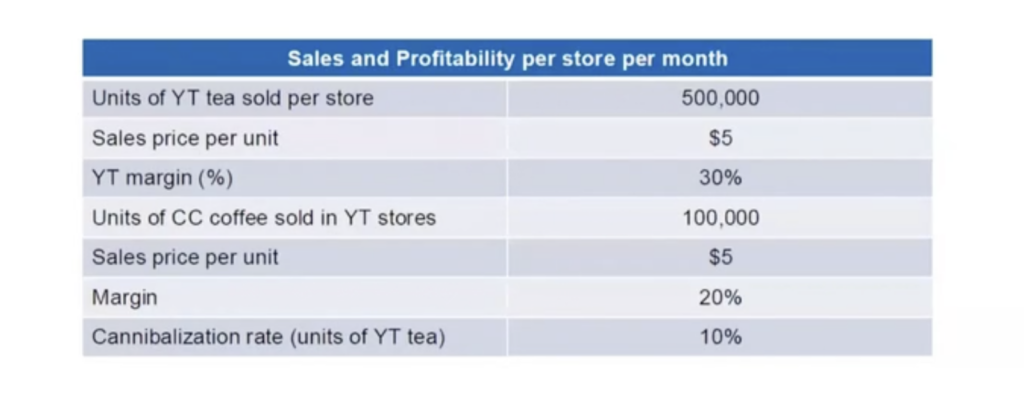
More Case Interview Resources:
- Interview Hub: Top free prep resources
- Black Belt Case Prep Program
- FREE Case Prep Plan
- Case Interview Guide
Transcription:
6:17
So thank you very much for this opportunity again.
So just to quickly summarize, we have a global bubble tea retailer, YoTea who is looking to see whether or not they should make an acquisition of Cool Coffee, a franchise based global coffee retailer.
6:34
To summarize, I'd like to approach this problem through three main drivers.
So the first is conducting a market analysis of some of the different geographies where each of the two entities are at play.
The second would be to look at Cool Coffee in a little bit more detail and understand its business model.
6:54
And the third driver would be to look at potential synergies that might be realized through an acquisition by YoTea.
If that sounds like a sensible approach, I'm happy to go through each in a little bit more detail.
So looking at the market analysis and again just to summarize, I'd like to do this across the different geographies where YoTea and Cool Coffee are at play.
7:18
I'd like to understand the size of each of the markets.
I think we have a few different markets here.
We're thinking about coffee, tea, probably other hot drinks, but also bubble tea, which I'd imagine is quite a specific market among those.
So to see what their size is and how much they're growing in respect to geographies, equally looking at consumer needs in each of these geographies.
7:40
So is there a demand for the different products that EATN Cool Coffee have and link that back to whether or not that demand is growing.
And then the Third Point within the market analysis would be to really look at competitors, so as to understand what other players are present in these geographies.
8:01
So do we have other bubble tea brands?
Presumably we've got the 1st and 2nd largest, which I'd imagine are pretty prevalent across some of these different countries.
But then looking at out of those competitors, what are their product lines?
8:20
Why they differentiated.
With respect to cool coffee.
And Yot's in terms of features, sorry about that.
I just turned that off in terms of product features, so taste and perceived quality, but also price point and understanding what the market share and what market share growth is for each of those competitors.
8:40
Moving on to the second driver, which is doing a bit more of a deep dive in due diligence on cool coffee.
So I think there are two main points to consider as first looking at the historical financial trends for Cool Coffee and then secondly looking at any sort of qualitative sources of competitive advantage.
9:00
So then financial trends obviously look at the revenue trends for Cool Coffee, is it a growing business?
Has its cost structure changed over time?
And following on from that, taking revenue and cost, what is happening to profitability and EBITDA with time, particularly thinking about the fact that we want this to be generating revenue, but also presumably cash within the first few years.
9:27
The second point, looking at competitive advantage, again, this would be coming back to looking at Cool Coffee's product line.
So thinking about the perceived quality, the price point, the different market segments within geographies that are being targeted by Cool Coffee at the moment and also thinking about their IP, which could be considered as a competitive advantage.
9:50
So brand equity, are they a well known brand across some of these different geographies?
Moving on to the third and final driver, which is looking at different synergies.
So there's a few different ways that we could approach this, but I've broadly categorized this into revenue and cost synergies.
10:08
So thinking about revenue synergies, it would really be thinking about sort of the branding synergies.
So for example, a or presumably Yot is the bigger brand.
So is there a sales uplift for a lot of the products acquired from Cool Coffee by attaching it to the YOT brand?
10:31
There's then the actual sales channels, specifically the marketing avenues.
So if YOT, I'd imagine is much stronger when it comes to branding, then a lot of Cool Coffees products can also appreciate a sales uplift there and then also Geo expansion.
10:47
So thinking about whether or not cool coffee is currently present in geographies where UT isn't, can we use that as a platform to to expand and launch a lot of the O TS products, but it was to grow the new business as a whole moving on to cost synergies, which is the final point within the synergies driver.
11:09
So this is thinking about potential economies of scale.
So obviously consolidation of a lot of the fixed cost.
So if we think about, for example, the C-Suite, but also actual retail locations, whether we consolidate the different shops into, and I'm thinking about how this will work with the franchise model, but I think that still applies whether we can consolidate different stores into two larger stores with a shared footprint effectively.
11:44
I think there's a lot more we can explore within revenue and sales synergies.
But with all of that in mind, I think it would be a good place to start if we look at a market analysis.
Yeah, great.
12:01
Let's look at the market.
So at the moment we don't have wide market data.
What we do have is just a view of what cannibalization might look like with this integration.
So before we talk specifically about what cannibalization could look like, I'd love to get your thoughts.
12:22
How might you, how might you evaluate cannibalization?
So the direct question is, as you're talking about synergies, right, revenue uplift from actually bringing cold coffee into or cool coffee into our YOT stores, how would you assess the profitability of actually starting to sell cool coffee in Yot's stores?
12:52
We'll be right back after this quick break.
13:36
So we're thinking about cannibalization, cannibalization and profitability at the same time.
Yeah.
Yeah.
OK.
So I can take just a couple of seconds to think about this plus profitability, so to tackle each of these in turn.
14:14
So I think first just to broadly outline how I would start to look at cannibalization and this is presuming we're not actually doing sort of real world data generation.
So we're not sending out surveys, for example, but looking at the two businesses, there's two main factors that I want to consider, which is first, their actual products and then secondly, the market segments that they're currently marketing to and selling to.
14:43
So looking at the products, I'd like to understand how they're differentiated from one another.
So is the perceived quality for example of YoTea coffee much higher than the perceived quality of cool coffee?
And are there potentially different price points that you could sell out there in terms of having a premium blend of coffee versus the everyday blend, for example?
15:08
If there's a lot of overlap and we don't think there's much scope for branding those products differently, then there will be a degree of cannibalization in terms of working out the actual share and, and what that's going to look like quantitatively.
15:25
I think it'd be helpful to do some consumer research.
I'm sort of on that net.
I think it's useful to understand the market segments that we're currently appealing to with different products.
It might be a completely different demographic of people who usually go to cool coffee compared to YoTea coffee.
15:44
There's implications for what will happen with a rebranding there, but there might be some scope to keep some of those market segments separate to prevent cannibalization.
But an answer I think there will be on both fronts.
So the different segments and product differentiation, a lot of overlap and cannibalization, how that impacts profitability is, is obviously going to potentially reduce the revenue.
16:11
You have made some cost synergies and cost savings theirs.
So it's which one prevails and what happens to profitability?
OK, great.
So lucky you.
We actually get to calculate the impact of cannibalization.
So I'm going to give you some information.
16:30
I'm going to ask you to take a screenshot.
Yep.
And the question is simply what would the financial impact of incremental revenue and cannibalization be?
So let me just share my screen.
16:48
Let me know when you've done the screenshot and then I'll stop sharing.
OK.
So as with the last question, I think it's probably helpful if I can just take a couple of seconds just to sort of orientate myself to the data and come up with an approach to determine the financial impact.
18:07
A couple of clarifying questions that when we say we want to understand the financial impact.
I'm presuming because we have.
Margin here that we're probably going to want to determine sort of a gross margin before and after the acquisition.
18:22
Is that what we're aiming for?
Yeah.
And I might just simplify it in your mind to say, ultimately the question is should we incorporate cool coffee or not?
And so then what would you evaluate to determine?
And that's I'm kind of leaving that as my rhetorical question with you.
18:40
What would you look at to ultimately determine should we include cool coffee or not?
Yeah, understood.
So I'm thinking more of either total revenue or total profit there.
Profitability.
Great.
Yeah.
OK.
And when we say, yeah, OK, So the cannibalization rate I think is fairly self-explanatory.
19:02
So I'm happy to just outline a brief approach.
Obviously, we want to try and determine what the revenue of YoTea is in the current status.
19:18
So units multiplied by the sales price, which would get us revenue multiplied by the margin, which is going to get us to that overall profit calculating the uplift that we get from all potential uplift to be determined from the acquisition.
19:35
So I'm then adding on the units of cool coffee.
So cool coffee units sold at a price times margin, but also taking away 10% of the units of the OTT.
19:51
So I'm happy to start crunching the numbers there and I'll start with the current status of play.
So that would be and I'm just realizing as well, we've got units per store.
20:09
So we're assuming that this is going to be the same across stores.
Yeah, we can assume this is an average effect.
Yeah.
So let's do it on a per store basis.
Cool, sounds like a plan.
So 500,000 units, which is sold per month multiplied by the price point of five would get us to $2.5 million in terms of revenue per month.
20:40
And then to work out the profitability, so times by 30%, which will be 30 and that would be $700 and $50,000 in terms of total profit per month.
21:03
So I'd like to compare that to what happens if we acquire cool coffee.
So the added revenue that we're going to get is going to be 100,000 units of coffee times, again by a price point of $5 equals 500,000 added revenue.
21:29
But then we've got to work out the cannibalization.
So that's 10% of 500,000.
So we've got -50,000 units times by 5, which comes to 250,000.
21:46
So overall, we've got an uplift of 250,000 and of that 250,000.
I've realized that I'm going to have to calculate the margin differently.
22:04
Let me just figure out how I'm going to do that.
So for the cool coffee, this is relatively straightforward.
So tell me, what was your revenue uplift from cool coffee that you calculated?
So the revenue uplift overall I got was 250,000.
22:25
Is that sounding a little bit off?
What is the calculation you're doing?
I'm just curious.
Sure.
So for that, I've gone with the units of oh, sorry, that was the revenue uplift minus the cannibalization effect.
22:41
Yeah, I want to know just without cannibalization effect, you're getting a revenue uplift of. 500,000.
OK, great.
Great with cannibalization which I calculated to be 250,000 and.
22:58
You just took it out of the cool coffee revenue, OK.
Overall, it's the 250,000 uplift, OK, is that, does that sound about right?
Let's see how you do then with margin and let's see what happens from there.
Yeah.
I was just getting to that stage.
23:14
So I think this is potentially going to be a little bit more complicated, but what I can do is say, yeah, let's just calculate the overall profit.
23:32
So we know that there's a 20% margin on cool coffee sales, which are currently at 200 and sorry, at 500,000.
So 20% margin would be 100,000 in profit from cool Coffee.
23:59
And then at this point, the overall revenue that we're getting from YoTea is 2.25 million and we've got to multiply that by the margin for YoTea, which is 30%.
24:15
So 2.25 * 0.3.
Give me a second just to calculate that.
So OK, plus 3/3.
I think that gets me to 675,000 for EAT.
24:42
And then if we add that together, I've got 775,000 in total profit from the combined organizations which have that combined revenue.
24:59
Again, they calculate the combined revenue, so there's an added revenue of 250.
So the combined revenue was 2.75 million.
Does that sound about right?
25:14
I think the takeaways from this are that we're obviously increasing.
If it is correct, the revenue that we are taking away is greater and we're equally increasing our profitability and profit, which is good to see or I should say, sorry, we're increasing our profit.
25:34
Our profitability is actually going down somewhat as we see a shift slightly towards the proportion of sales coming from the lower profit margin.
Cool coffee.
All of this needs to be taken in light of the acquisition costs, an additional cost that we might experience through this sort of transaction.
25:57
But so far, it seems like a top line and at least ongoing profit not accounting for the acquisition cost is positive.
Yeah.
So what was the net change in profitability by bringing in cool coffee?
26:17
Sure.
So I can calculate that.
So just to clarify in terms of would you like a margin so to get to a percentage profitability?
I'd like a dollar figure for what the net profit is once you account for cannibalization.
26:34
Like how much is how much we should make profit wise after we account for cannibalization?
So with the figures.
That I have here we went from 750,000 which is pre acquisition $750,000 of profit to after cannibalization we or from my calculations have $775,000 of profit is that?
27:01
Got it.
So a net, a net 25 K gain, is that fair?
Is what I'm hearing saying that this integration would be 25,000 positive in terms of profit?
Yes, that's what I've calculated.
27:17
Sorry, I misunderstood your question.
That's alright, no?
All good, all good.
That's great.
That's great.
OK, so now that I've heard it's it's I was probably just looking for a specific phrase when I'm with you.
So now tell me, reflect on that 25 K and what do you want to do next?
27:34
And you've already started going there.
I'm just going to have you repeat it.
Sure.
So I think ultimately an increase in profit of 25,000 on a business that's already at 750,000 is relatively marginal.
27:55
It obviously depends, obviously, it depends, sorry, how much additional growth can be achieved in terms of some of the positive synergies that we spoke about.
But I think all of this needs to be tempered in light of what the acquisition cost is.
So if we're paying a relatively low price proportionately and I can't remember off the top of my head what would be a good sort of price to EBITDA multiple, but we need to take into account how much this is going to cost to see whether or not it's a sensible acquisition.
28:29
Great.
Really nicely done.
I'm going to pause it here because this is a relatively short case and in a way you that's essentially the recap of the case as well.
You're basically saying we might go for this, but we want to look at how much this company is actually going to cost us.
So great job.
28:46
Let's pause here.
I'm going to give you a round of applause and everyone on the call, please give James a round of applause.
Awesome job.
So how do you feel?
Yeah, there were a few bits that were slightly tricky.
I mean, I hope overall I've sort of driven the case in broadly the right direction, but there's always more you can say.
29:07
There were definitely bits where I could have been much more structured in my answers.
I think the synergies are part of my structure, I realized I was running out of time.
So tried to sort of ad Lib that a little bit as you could probably tell.
But yeah, hopefully the maths when occurs knowing exactly like you say the answer that the interviewer wants you to give.
29:29
So I probably didn't give you, you did say net and I think I got confused with sort of net profit versus net change.
So I could have been a bit quicker with getting you that answer.
But yeah, overall a good case.
So thank you.
Yeah, great.
29:45
So here's what I'll say to you and for folks on the call, this is definitely a round one case.
I would call this on the easier side of a round one.
And for what it's worth, I would pass you from round one to Round 2, James if this were the case.
So let that be a calibration for you and for folks on the call.
30:04
So let's, I'm just going to go part by part in the case and we'll talk about what went well and a few refinements.
I mean, big picture, my refinements are going to be at the margins.
There was no red flag.
I saw that I dramatically want to shift a few things I'll offer I hope can just help in delivery and just make maybe a bit more succinct for you, for you, that's it.
30:26
Sounds good.
So the recap, really beautifully done.
I think you got the big beats of the case.
Again, this wasn't a very complicated prompt, so you captured what you needed to capture.
My one pro tip I would offer is anytime you can find an analog like a real life company that is like your client the better.
30:47
So you may not be a big bubble tea drinker but what might?
Do you know any bubble tea companies?
Like international ones?
Or do you know international ones?
OK, yeah, so right away I want you to do some way to personalize or relate to the case.
31:03
So I'm not a big drinker.
I do know that cocoa bubble tea or VV bubble tea I think are big companies.
Right away, I want you to just say out loud like, you know, I don't know global companies, but I'm going to actually visualize or imagine the bubble tea that I go to in London here called XYZ looking to make this acquisition.
31:22
And the reason I'm going to encourage you to do that is when you get to your structure, I want you to make it a bit more real world and imagine that you are actually a customer potentially going into a bubble tea shop and making that decision about coffee versus bubble tea.
It'll just make it more real world and specific.
31:40
Moving on to your clarifying questions.
I thought they were good questions.
You delivered them in a clear, succinct way.
I knew what you were asking and why, and I think the information you were looking for was relatively valuable.
A couple of refinements or pro tips I'll offer candidates.
32:02
I had noticed they kind of danced around the question of what is a financial target?
Are there additional goals?
I think the question that people really want to ask is what metric matters most to our client and making this decision.
And I don't say financial metric.
32:19
I specifically say metric because you might be dealing with a client that's not a business, right, that has other outcomes that it's oriented towards.
So my recommendation is whenever you want to know, like the target, just ask the question some way, like what metric matters most.
My second recommendation is anytime you ask a question, I want you to have a point of view on what you think the answer is.
32:44
So when you told me, when you asked me if the only target is growth orientation towards revenue maximization, the way you might have phrased it is what metric matters most.
My instinct tells me at least, you know, in the first couple of years they want to make sure they're increasing revenue or maybe they want to be, you know, profitability positive in year 1.
33:08
Yeah.
Second pro tip, is the franchising model kind of a big deal or a big part of this?
And I'm going to call the franchising model both a part of their business model, but it's also part of their operating model, right?
33:24
Because companies that have 90% of their footprint under the control of individual business owners, that might add a little bit of complexity when you think about integration.
So my recommendation is, and you might know how franchise models work at a minimum, and this is kind of for everyone on the call, use your clarifying questions to get crystal clear on anything you need to understand for the business model slash operating model of a company.
33:54
So the question might look something like, you know, I want to just confirm my understanding of what we mean by franchise.
When we said 90% of the stores are franchises, what I understand it means is that the stores that are under franchise, you know owners are running it, we're providing stuff centrally and there's some sort of profit sharing that's happening and you get to confirm that that makes sense.
34:20
Cool.
And then I think in any sort of acquisition like MNA case, I think asking the like, why now or why this target is always interesting if you need a question.
So like, what is it about cool coffee beyond maybe the obvious synergies of like them being drinks is interesting to your tea.
34:45
And the reason I want you to start thinking about that is I probably wanted you to explore that a little bit more in your structure.
So let's move into your structure now and actually pause there.
Any questions, any questions on clarifying questions?
Cool, cool.
On your structure.
35:02
I'm going to share some just like best practices, take them or leave them.
I like 4 by 3 structures, which means 4 bullets, excuse me, 4 buckets, 3 bullets and right away I'll say a good fourth bucket always has risks.
35:20
So it's always nice to think about risks early on in the case because you're probably going to have to talk about them anyway when you come towards the end synthesis.
So you know, I cannot tell myself how I am supposed to think about four buckets?
Well, the beauty is you already have your 4th bucket, so you're really only thinking about 3.
My second, my second.
35:39
Just general best practice is no need to be polite.
And this might be the Brit in you, but at least I would say no need to kind of say these are the lenses I want to look at.
How does that sound?
Or does that sound OK?
You just kind of jump right into your structure.
35:58
And then my third general best practice, once you come out of your structure, there's two sentences I like to close slash transitions.
My structure with sentence one is something like, you know, with this, with the early information that we have, my emerging answer, my emerging hypothesis is, yes, you OT should invest whatever your emerging hypothesis is.
36:23
But yes, you OT should invest in or acquire cool coffee because what I think we'll find is the cool coffee market is growing and the synergies will make it worth it.
That being said, what I want to 1st investigate to further validate that early answer is the market for cool coffee.
36:41
So there's basically 2 sentences, right?
Sentence one is your early answer in the hypothesis.
Sentence 2 then is the data you would want to validate.
Cool.
Thank you.
Yeah, that's really helpful.
So now let's talk about your structure.
36:58
Overall, I thought the structure was it was a, the content was good, the delivery was clear.
My one like NIT is going to be how do we make three clean bullets per bucket because I want it to be consistent and we'll talk about how you might have done that.
So under the market analysis, I like that you were specific to basically say I want to do a market analysis by geography for each of our two entities. The first thing I want to look at it's just the size of drinks and bubble tea generally and the growth.
37:27
The second you told me you want to look at customer needs, which you basically described as demand.
What I got curious about is how is that different from the size of the market?
So is it me?
See.
Yeah.
I guess I was trying to look at it a little bit more qualitatively, but yeah, that's at that point.
37:47
I think what you were, it's funny because you said customer needs and you said demand and those from your two different metrics.
So I think what you might have been looking for is what matters or what preferences do customers have, right?
What do they care about in their drinks when they go into a coffee shop?
What makes them make the purchase?
38:05
And that's a great question to ask.
And then third, you talked about competitors and you had a lot of good sub bullets under competitors, right.
Who are the players in the different geographies, What is their product, product differentiation and price, What is their respective market share and growth?
38:28
My delivery feedback, and again, this is at the margins, you did a fine job, but my delivery feedback to you would be the most that you can frame.
Let me just put this example in the chat for everyone to see what I wrote down just in case it's useful.
38:44
The more that you can frame the front part of each of your bullets as what I'm going to call an open-ended research question and then give some commentary on specifics, the better.
And what that does is it cleans up your speaking and it kind of cleans up the analysis.
39:00
So it might have looked something like this.
So under the market analysis, there's three questions I want to understand.
What is the size and growth of the drinks and bubble tea market generally over the next three years?
And are the geographies that we care about #2 what, what do customers value when going into a store and making a purchase and then deciding what they want to what they want in their drink?
39:27
And to figure that out, I'd want to do some customer research in our primary geographies.
And finally, what is a competitive landscape specifically, who are the top three players in the geographies we care about and what is their share and what differentiates their product?
39:45
So it's like framing an open-ended research question, then with commentary that's like a sentence.
And that'll help with the timing of your delivery as well.
Very helpful.
Thank you.
Cool.
I'll say a few other things about this structure, then we'll move to math and then I want to make sure I leave time for Q&A.
40:06
So under the company, great.
You want to look at just the financial health of cool, cool coffee.
I think you get to say it as simply as what is the financial health of this company.
For example, what is this profitability in EBITDA and how is that expected to grow, right.
40:23
Second, what is this company's competitive advantage in terms of its brand equity, its perceived quality and you know, it's what customer feedback looks like today on the market perception.
And 3rd, what else might you want to know about this company?
40:47
If you think about it from an execution standpoint, like I think geography, footprint, anything you think of, right, you can just imagine like from an execution standpoint, what do I want to know?
Oh yeah.
Where are their stores?
So you can just get a sense of like what's the geographic map of Cool Coffee or you OT?
41:02
And the reason I care is once we actually bring these companies together, the footprint's going to matter.
And then finally, synergies for acquisition synergies were great.
I think, yeah, here I'd have the same feedback of just what are revenue synergies, for example, branding.
41:25
Does Cool Coffee get the uplift?
Do we get more geographic expansion? This cool coffee gets more geographic expansion on cost synergies?
I loved your two examples, C-Suite essentially people and then retail locations.
And 3rd, it's interesting because I would have put cannibalization at risk.
41:47
So I might call your third this this third bucket from you would probably be yeah, like yeah, benefits of this acquisition or synergies with the acquisition.
I'm trying to think of other qualities, I'm trying to think of Yoti with the qualitative benefit, and this is where a little bit of creativity comes in.
42:12
There might be just creators like new geographies that you can enter because your menu is not just bubble tea, because we know that bubble tea, it started as an East Asia phenomenon and now it's much more global.
But having a third benefit would be good.
And then I'd want you to have that 4th bucket that definitely talks about cannibalization, which I think was a bit of a miss here.
42:31
And the other risk that I want to make sure that you talk about is this franchise model.
How are we integrating partnership agreements, revenue share, all that because I will be part of it.
OK, let me jump.
Let me jump to math.
Ultimately you got the answer right, Yay.
42:48
And I thought the approach that you laid out to start was great. You basically said there's three things I want to look at.
What is revenue today for your T and profit?
What would the revenue uplift and profit uplift look like from Cool Coffee?
And then what would cannibalization look like?
43:05
The one hack I would hear it do here is the simple cannibalization calculation you could have done is just take the 10% times all the numbers for your T because you would basically say that's the money we're losing with cannibalization.
43:20
You know what the profit uplift is with cool coffee, which was 100K and then you do the subtraction . You get a 25K lift and I think that would have just made your process simpler.
Yeah, I made my life hard with that one.
Yeah, but you, you got there your, your logic was sound on my two pieces of feedback and then I'm going to open it up. 1 is when you get the number, I want you to reflect on that number at 3 levels.
43:45
So the first thing I want you to look at is just what is the number say?
And you did a nice job of that.
You're like, well, we're, we're making more money. 25K it's, it's a small amount of money relative to what we're making, but it's net positive.
So then once you've said something about the number, the second thing I want you to do is take a real point of view on what the client should do, which you basically said, yeah, let's go for it.
44:06
Cool coffee seems net additive.
And then that being said, the two pieces of data I'd want to understand to further validate the fact that we should go for cool coffee are, you know, acquisition costs and then a fair multiple.
44:22
So you had all the right content.
I'm just going to add advice, just kind of pithy delivery.
And then the second piece of feedback is, and this will just come as you do more reps again, when you get a math question, I actually want you to start speaking right away and you're speaking can be the recap and the orientation.
44:42
So you said, let me take a moment to orientate the data.
I actually want you to just start speaking out loud while you're orienting yourself to the data.
So it might have looked something as simple as great.
So we want to understand what the cannibalization and profitability impact is of bringing in cool coffee.
44:58
The graph I have in front of me is basically telling me, you know, number of units, price, margin for OT, same information for cool coffee.
And we have a metric of 10%, which just conceptually is telling me before once we put in cool coffee and we're losing 10% of sales every month and you're just doing kind of a live interpretation of data.
45:21
OK, cool.
I'm going to pause there first James, to you.
Any questions, concerns, things that are coming up and then we'll go to the chat slash, open it up to the group.
No questions for me.
So really good case, really interesting and super helpful feedback.
45:40
So thank you very much again to everyone at the management consulting team.
Thanks for tuning into this McKinsey case demonstration.
If you're loving the podcast, we'd love your rating and review.
So take a second, pause the episode and go.
45:55
And wherever you're listening, Apple, Spotify, elsewhere, leave us a quick rating review.
And it does help the show reach more listeners.
All right, we'll see you again in the next episode.