How New H-1B Visa Fees Could Reshape Management Consulting Hiring in the U.S.
Estimated Reading Time: 4 minutes
Key Insights:
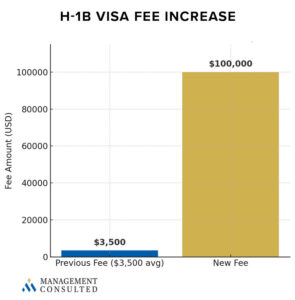
H-1B Visa Changes: U.S. consulting firms will pay an additional $100,000 in fees per new H-1B worker they hire. This policy does not affect current employees on H-1B visas.
Hiring Implications: 15%-25% of U.S. consulting hires are non-U.S. citizens or permanent residents; hiring from this cohort will now be cost prohibitive for many firms.
Salary Implications: Consulting salaries have risen by <2% in the last two years. The new policy will put upward pressure on salaries in the consulting sector as firms compete for a smaller pool of domestic talent.
Candidate Implications: MBA candidates and specialist hires are most likely to be affected.
The recent changes to the U.S. H-1B visa program, most notably the addition of a $100,000 fee per new worker, stand to reshape the talent landscape in the management consulting industry. While consulting roles are not typically considered "low-cost" positions, the magnitude of this increase makes sponsoring new H-1Bs economically unattractive for many firms. The impact will not be felt evenly: top-tier firms are more likely to be able to absorb these costs, while mid-tier and boutique firms could find them prohibitive.
H-1B Fee Implications
Why does this matter? From pulling together disparate data sources, our best estimate is that roughly 15%-25% of consulting new hires in the U.S. are non-U.S. citizens / permanent residents.
Two candidate pipelines drive the bulk of this international intake: MBA students and specialist hires (e.g., AI experts).
As we’ll unpack in a minute, this has enormous implications on firms’ competitive positioning for talent, as well as future salary growth across the industry, which has grown at less than 2% over the past two years.
Who Is Affected By The New H-1B Policy?
Importantly, existing H-1B holders and extensions are not expected to be affected by this change. This means consultants who are already employed in the U.S. under valid H-1B status may continue their work uninterrupted. However, the effect on new international hires – particularly those recruited from MBA programs – could be profound.
Some consulting firms (especially technology and IT firms) rely heavily on international students from top U.S. business schools, and these candidates may now face reduced opportunities due to the additional $100,000 cost burden of sponsorship.
Transition Pressure from F-1/J-1 to H-1B
F-1 visa holders (often in Optional Practical Training or STEM OPT extensions) rely on securing an H-1B to continue working in the U.S. beyond their limited work authorization. With the additional $100K cost, many firms will be less willing to sponsor them unless they possess in-demand specialized skills.
J-1 visa holders (often in internships, research, or trainee programs) face a similar challenge. To convert to long-term employment, they generally need an H-1B sponsorship. The fee increase makes that conversion more difficult, especially outside of the top firms.
Our prediction? Mid-tier and boutique firms are more likely to pass over F-1/J-1 candidates entirely because the sponsorship costs don’t align with their economics. Instead, they’ll lean more heavily on domestic applicants.
Options for International Students
Some international consultants may explore O-1 visas (for individuals with "extraordinary ability") or L-1 intra-company transfers (if they start outside the U.S. and transfer in). These are limited, and individuals must show a track record of "top performance" to win firm sponsorship.
We also expect to see increased competition for OPT-friendly roles. More international students may accept short-term roles under F-1 OPT even if long-term sponsorship is uncertain, increasing demand for firms that do still sponsor.
Finally, we've been encouraging international clients for years to start in offices where they already have work authorization (London, Toronto, Singapore, etc.) and then seek a transfer to the U.S. later. You have much more leverage with a firm when you are a known commodity.
H-1B Policy Implications for Consulting Industry
For firms, the implications are multi-layered:
The recruiting pipeline will be disrupted, with fewer international students receiving offers.
With fewer H-1B applicants in the mix, competition for U.S. citizens and permanent residents will likely intensify, pushing up compensation. This should be especially pronounced at the MBA level. We expect compensation effects at the undergraduate and PhD levels to be muted.
While top firms such as MBB, Accenture, and others may continue to sponsor to secure specialized talent, boutique firms may be forced to step back, deepening disparities in talent access across the industry.
Firms with offshore support centers may lean more heavily on global delivery models as an alternative to costly U.S. sponsorship, unless potential outsourcing taxes are also introduced.
In the short term, salaries are likely to rise at the post-MBA consultant levels as firms compete for a smaller pool of eligible hires.
In the medium term, if outsourcing faces new taxation, firms may be compelled to double down on U.S.-based hiring, driving salaries even higher.
Over the long term, legacy firms are best positioned to maintain stability by absorbing these costs, while smaller firms may face increasing difficulty in both talent attraction and wage competition, potentially reshaping the labor market for consultants.
Ultimately, the issue for consulting is not merely one of cost efficiency. Instead, it is fundamentally about access to top talent at the very top of the recruiting funnel. This new policy has the potential to reshape recruiting strategies, heighten competition for domestic candidates, and force boutique firms to reconsider their hiring models altogether.