Core Skill Tested: Market sizing evaluates your ability to structure ambiguous business problems, make logical assumptions, and communicate clearly under pressure.
Consulting Application: Firms like McKinsey, Bain, and BCG use market sizing to assess whether candidates can think and communicate like real consultants.
5-Step Framework: Success depends on clarifying scope, presenting your approach, explaining assumptions, showing clean math, and ending with insight.
Market sizing is one of the most common and essential case interview exercises used by consulting firms. It tests a candidate’s ability to break down ambiguous business problems, make logical assumptions, and communicate clearly while remaining organized.
Every major consulting firm (including McKinsey, Bain, BCG, and the Big 4) incorporate market sizing into their cases - either as standalone questions or as the math part of a longer case.
While there are many ways to size a market, in consulting, the most common approach is to size a market in terms of annual revenue. The goal isn’t to arrive at the “right answer.” interviewers want to see how you think: Can you structure a problem clearly? Can you make reasonable assumptions? Do you sanity-check your results?
The exercise mimics real consulting work - in essence, you’re building a spreadsheet on paper and starting the model using estimated inputs. Then, you walk your interviewer (who is role-playing a client) through your thinking, explaining why you made certain estimates and what the implications are of your numerical answer.
A consulting job requires you to analyze markets and make strategic recommendations with limited data. If you can’t do it in an interview, how do you expect to do it with a client CEO in the boardroom?
For candidates, mastering the market sizing framework is the first step to becoming a confident "caser". This article explains what market sizing is, how to apply a consistent approach in a market sizing case interview, and our proven 5-step process to answer any market sizing question.
What Is Market Sizing?
Market sizing is the process of estimating the total market for a product or service. Most commonly in a consulting context, market sizing is measured in annual revenue.
Beyond sizing total revenue opportunity, the analysis helps answer questions like:
“What are the customer segments that drive revenue in this market?”
“Should we enter this market?”
“Do we introduce this new product?”
In many ways, market sizing is the foundation for strategy work, including market entry and market study cases. Clients must understand the total revenue opportunity before moving on to secondary questions like:
“How much of this revenue can I capture?”
“Is this a consolidated or fragmented market?”
“What is the market share of the three biggest players?”
In a case interview, market sizing takes the same idea but tests it in a simplified format. You might be asked to size the market for diamond rings in Denmark (that result might surprise you!) or disposable diapers in Texas.
The point isn’t to arrive at a “right” answer, but rather to demonstrate a structured, logical thought process that leads to a reasonable answer.
Why Market Sizing Matters in Consulting
Market sizing questions are not random puzzles. They reveal how a candidate thinks under pressure and how they might perform on client projects. Consulting firms use market sizing case interviews to test three major skills:
Structure: Can you organize a logical problem-solving approach?
Problem-Solving: Do you arrive at an answer that makes sense? And can you do it within the time constraints?
Communication: Can you do quick, accurate calculations? Do you explain your logic clearly and concisely in a way that the interviewer can follow without looking at your paper?
Displaying these skills across market sizing questions in interviews signals to employers that you can think like a consultant from day one.
How To Do Market Sizing In A Case Interview
When you receive a market sizing question in a case interview, the goal is to highlight those three core skills: Structured thinking, problem-solving ability, and clear communication. The interviewer is not looking for a perfect answer, but for a strong process that reflects how consultants think. Each step below builds your logic layer by layer, turning an ambiguous question into a well-structured business estimate.
Step 1: Ask Clarifying Questions to Limit Scope
Before you dive into the numbers, take a moment to clarify exactly what the interviewer is asking. This shows that you know how to define boundaries and reduce wasted effort. Consultants never start analysis without scoping.
Confirm the Goal and Units: (assume annual revenue).
E.g., When you ask me to size the market for diamond rings in Denmark, I assume you’re looking for an annual revenue figure. Can you confirm?
Limit Scope:
Geography: E.g., I understand dishwashers aren’t as common in Mexico. When you ask me to size the North American market, can I assume we’re talking about the U.S. / Canada only?
Customer Type: E.g., I would think that the residential part of the dishwasher market is much larger than the commercial side - can I focus my analysis there?
Product or Service: E.g., When sizing the market for bicycles, I am going to focus on manual-powered units with two wheels - is this okay?
Confirm Exclusions: Identify what is out of scope, such as accessories, secondary services, or the secondhand market.
This should take 1 minute.
Step 2: Walk Interviewer Through Your Approach
Once you’ve limited scope, you’re still not ready to dive into the numbers. Now, it’s time to walk the interviewer through your problem-solving approach. Tell them what you’re going to do before you do it.
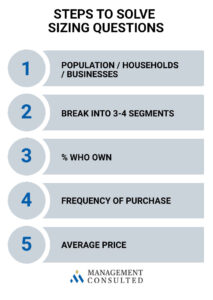
A visualization of our 5-step, top-down approach is below. This should always be your default approach to solving a market sizing problem.
Note that the 2nd part of your approach is segmentation - pick one way to segment the market (age, income, geography, etc.). There is no need for multiple levels of segmentation in this setting.
End this walkthrough by asking a question: “How does this approach sound to you?” This showcases the ability to lead with a perspective while welcoming feedback before you begin work. This is exactly the balance that top firms are looking for new consultants to strike.
This should take 2 minutes. Once you’ve gotten sign-off from the interviewer, then you can move on to the next step.
Step 3: Walk Interviewer Through Your Assumptions
Once you’ve walked the interviewer through your approach, go back and plug in your assumptions for each part of the process.
Explain why you’re making the assumptions that you are. Your rationale can come from personal experience, background knowledge, etc. Here are some guidelines:
Use round, easy-to-calculate numbers (e.g., U.S. population = 330 million).
Explain your logic briefly (“Most adults own one phone, replaced every 3 years”).
Reference external facts you know (“Average household size is ~2.5 people”).
It should take you 2 minutes to walk the interviewer through your assumptions. End with a question - “How do these assumptions sound to you?”
At this point, the interviewer may have questions or pushback to your assumptions. Stand your ground when questioned, but signal openness to changing your mind if the interviewer would like you to.
The more pushback you receive, the better you’re doing in the interview!
Step 4: Walk Interviewer Through Calculations
By this point, you have a problem-solving approach as well as numbers that you’ve plugged into it.
All that’s left for you to do is the math across your paper. You do these calculations out-loud so that they’re easy to follow, and so that you can catch small mistakes before they snowball.
Multiply in short steps and keep track of your units.
Round only at the end of the process to avoid compounding errors.
Write partial results clearly so you can reference them.
If you make a slip, correct it calmly and continue; self-awareness is a good sign.
After you calculate, pause and test whether your result makes sense. A quick comparison to known data proves you think like a consultant. If your number feels high or low, identify the lever that might be off.
The end result? You should arrive at a numerical answer in 2 minutes.
Step 5: End With An Insight
Once you have a basic estimate, think about how to make it more insightful for business use. Do you think the market is large or small? What would you want to explore about the market next if you had the opportunity?
Presentation is everything in consulting. Even a reasonable estimate loses impact if poorly explained. Summarize your results the way you would to a client executive: headline first, then reasoning, then insight.
Headline: Start with your conclusion (“The market is about $15 billion per year”).
Drivers: Briefly name the key customer segments you think drive this number.
Insight: What do you think about this number?
This should take 1 minute.
Worked Example Using The Full Framework
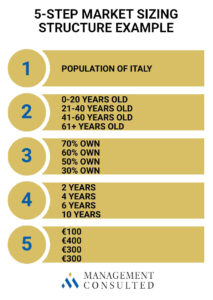
See below for how we applied the market sizing framework to answer the following question: “Size the market for bicycles in Italy.”
We clarified that we’re only focused on residential bicycles (no e-bikes, bike rentals, etc.)
We assumed that the population of Italy is 60M people, and that the population is evenly distributed (i.e., each age segment is equal in size). Can you work out the numerical answer?
Deep Dive On Top-Down Vs Bottom-Up
Our preferred market sizing approach in case interviews is the top-down method. Each method has its pros and cons, and you’ll use both on the job. Top-down works well when macro data is easy to recall. Bottom-up shines when micro activity or store-level data is more intuitive.
Top-Down Steps:
Start with a large base (like population).
Segment by characteristic (e.g., age, income).
Filter by participation (percent of ownership).
Identify replacement rate (also known as frequency or purchase).
A short, confident summary that feels client-ready.
By practicing these steps repeatedly, you’ll develop a natural rhythm for market sizing questions. The process becomes second nature, and your interviewer will see you as a candidate who already thinks, problem-solves, and communicates like a consultant.
Market Sizing Questions
Common market sizing questions are tough to identify, since market sizing questions can focus on any kind of product or service. Here is an example of a market sizing question.
What is the size of the bottled red wine market in the U.S.?
This question tests your ability to handle a consumer product with wide usage but different consumption patterns across demographics. Our top-down approach works best here because you can start with total population and narrow by percentages.
U.S. population: 330M (75% adults → ~250M adults)
Segment by age:
21-40 years old (35% of adult pop: 87.5M people)
41-60 years old (35% of adult pop: 87.5M people)
61+ years old (30% of adult pop: 75M people)
Identify percentage of each segment that consumes red wine:
21-40 segment: 30% (26.25M people)
41-60 segment: 40% (35M people)
61+ segment: 25% (18.75M people)
Replacement rate (how many bottles does each segment drink each year?)
21-40 segment: 12 bottles
41-60 segment: 18 bottles
61+ segment: 10 bottles
Average price paid per segment
21-40 segment: $12 per bottle
41-60 segment: $18 per bottle
61+ segment: $15 per bottle
Answer: U.S. red wine market size is ~$18B annually.
What makes market sizing questions common is their ability to force candidates to apply structure to ambiguity. Practicing with a wide range of examples helps you build confidence and speed. Our drills ($95 for 1 month) are a great place to start.
Market Sizing Cheat Sheets
This section includes key data points useful for any market sizing case interview. This reference saves time and provides a sanity check for your assumptions.
How to Communicate Your Market Sizing in an Interview
Even if your math is perfect, communication can make or break your performance. Interviewers assess how clearly you guide them through your reasoning.
State your approach first. “I’ll start with the total population and segment by income.”
Explain your assumptions. “I assume 5 percent of households own an electric vehicle just based on the number of EVs I see in my neighborhood.”
Show your math clearly. Speak slowly and check logic as you go.
Summarize your result. “Based on these assumptions, the market is about $15 billion annually, which seems reasonable given industry scale.”
This style mirrors how consultants present to clients, which is logical, confident, and concise.
Market Sizing Common Mistakes
Even strong candidates make errors during a market sizing case interview. Here are the most frequent pitfalls:
Jumping into math too fast: Always define structure and limit scope first.
Unrealistic assumptions: If you assume that 0% or 100% of a segment does anything, your credibility drops.
Messy math: Rounding inconsistently or skipping steps confuses interviewers.
Weak communication: Mumbled or disorganized explanations signal poor consulting fit.
Avoid these mistakes by practicing aloud, focusing on logic over exact numbers, and keeping your answers structured.
Market Sizing Tips
To excel in a market sizing case interview, apply these tips used by top candidates:
Practice problems in different industries. Don’t just do consumer goods, try healthcare, tech, energy, and automotive.
Memorize anchor data. Know core stats like U.S. population, GDP, and average household size.
Use round numbers. Simplify calculations for clarity.
Check reasonableness. Always ask, “Does this seem realistic?”
Be flexible. Interviewers may change parameters mid-case to test adaptability.
Communicate like a consultant. Walk your interviewer through your logic step-by-step.
Learn from feedback. After each practice case, review your structure and assumptions. The more you practice, the more intuitive market sizing becomes.
Conclusion
Market sizing is one of the most powerful frameworks in consulting interviews. It tests structured thinking, logical estimation, and clear communication, the exact skills consultants use daily. By mastering market sizing questions and practicing this framework, you can turn uncertainty into confidence during any case interview.
To take your prep to the next level, explore the Black Belt Case Interview Program. You’ll work directly with former McKinsey, Bain, and BCG coaches, complete real market sizing drills, and learn how to apply frameworks with precision and clarity. You can also access our Consulting Job Board and Consulting Salary Report for deeper insights into firm opportunities and compensation.