Key Insights
- Clear Role Assignment: The DARE model assigns every stakeholder a defined role, so decisions move forward without confusion or wasted time.
- Decision Maker Focus: Unlike RACI, DARE explicitly identifies who has the final say, reducing conflict and bottlenecks in complex projects.
- Practical for Consulting: The DARE framework maps directly onto consulting engagements, from senior client executives down to the analysts doing the analysis.
The DARE decision making model is a role-clarity framework that helps teams identify who decides, who advises, who recommends, and who executes on any given project. It was developed as a practical alternative to the RACI model, with a stronger emphasis on pinpointing the final decision maker and reducing organizational confusion.
What Is the DARE Decision Making Model?
The DARE decision making model is a framework companies use to streamline the decision making process. It clearly delegates employees into specific roles and makes it obvious who the decision maker is at every stage. The model was designed to fix a common problem in large organizations: people do not know who has the final say, so decisions stall, projects slow down, and accountability disappears.
The DARE framework is often positioned as a direct alternative to the RACI framework. While RACI identifies who is Responsible, Accountable, Consulted, and Informed, it does not clearly define who the decision maker is. The DARE model fills that gap by putting decision authority front and center.
What Does DARE Stand For?
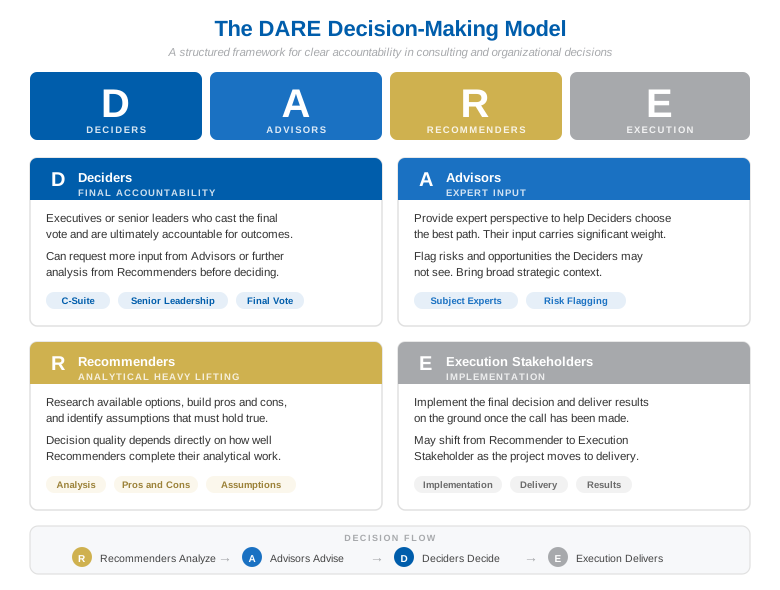
The DARE decision making model stands for Deciders, Advisors, Recommenders, and Execution Stakeholders. Each letter represents a distinct role with specific responsibilities in the decision making process.
D: Deciders
Deciders are the executives or senior leaders who are ultimately accountable for the project outcome. They are the individuals who cast the final vote on which direction to take. Because the stakes are high, Deciders can request additional input from Advisors or ask Recommenders to run further analysis before making their call. In most organizations, this role belongs to a C-suite leader or senior department head.
A: Advisors
Advisors provide expert input to help Deciders choose the best option. They do not make the final call, but their perspective carries significant weight. Advisors are typically experienced leaders, subject matter experts, or senior consultants who understand the strategic context and can flag risks or opportunities the Deciders may not see directly.
R: Recommenders
Recommenders do the analytical heavy lifting. They research the available options, build out the pros and cons of each path, and identify what assumptions need to hold true for each option to succeed. The quality of the Decider's final choice depends directly on how well the Recommenders do their work. Incomplete or poor analysis leads to poorly informed decisions.
E: Execution Stakeholders
Execution Stakeholders are the doers who implement the final decision once it has been made. While Recommenders focus on building the case for a decision, Execution Stakeholders carry that decision across the finish line. They are responsible for delivering the actual results on the ground. In some projects, the same people may shift from Recommender to Execution Stakeholder as the project moves from the analysis phase to the delivery phase.
DARE Decision Making Model Examples
The DARE model can be applied across any corporate setting. One of the clearest use cases is a consulting engagement, where multiple stakeholders from different organizations must collaborate on high-stakes recommendations.
Consulting Engagement Example
Here is how the DARE decision making model maps onto a typical consulting project:
- Deciders: The client's senior leadership, such as the CEO, CFO, or COO, who will approve or reject the final recommendation.
- Advisors: Engagement managers, associate partners, principals, and partners who guide the client toward the best path forward based on experience and strategic insight.
- Recommenders: The broader consulting team, including analysts, associates, and engagement managers, who build the options, run the analysis, and surface second and third level insights.
- Execution Stakeholders: The client's internal team who takes ownership of the approved recommendation and implements it after the engagement ends.
Internal Corporate Example
The DARE model also works well for internal decisions within a single company. For example, if a company is deciding whether to launch a new product line:
- Deciders: The executive team or board who approve the budget and greenlight the launch.
- Advisors: Department heads in marketing, finance, and operations who weigh in on feasibility and risk.
- Recommenders: The product and strategy teams who research market demand, run financial models, and present a recommendation with supporting data.
- Execution Stakeholders: The product development, supply chain, and sales teams who build and bring the product to market.
How to Use the DARE Decision Making Model
Applying the DARE model effectively comes down to clearly assigning roles before work begins and making sure every stakeholder understands their responsibilities. If roles are blurred, such as an Advisor who believes they are a Decider, the process breaks down quickly.
- Identify the Decision: Define the specific decision that needs to be made and what a successful outcome looks like.
- Assign Roles: Map every key stakeholder to one of the four DARE roles. Avoid assigning the same person to multiple roles where possible.
- Brief Every Stakeholder: Make sure each person understands what their role means, what they are expected to contribute, and who they report to or consult with.
- Set a Decision Timeline: Agree on when the Recommenders will deliver their analysis, when Advisors will provide input, and when Deciders will make the final call.
- Document the Decision: Once the Deciders have made their choice, document it clearly and brief Execution Stakeholders so they can move forward without delay.
As a junior employee or analyst, a practical way to apply DARE is to ask your manager early on: who is the Decider on this project, and who needs to be in the room when that decision is made? Getting this clarity upfront saves significant time and prevents rework later.
DARE Decision Making Model in a Consulting Career
For consultants, the DARE model is more than a project management tool. It is also a useful lens for thinking about your own role on an engagement and how to add value at each stage. Understanding where you sit in the DARE hierarchy helps you communicate more effectively with senior stakeholders, prioritize your work, and build credibility quickly.
Junior consultants, such as analysts and associates, typically operate as Recommenders. Their job is to produce airtight analysis and clear, structured recommendations. As consultants progress to engagement manager or principal, they shift toward the Advisor role, shaping the direction of recommendations and coaching the team. Partners and client executives occupy the Decider role.
If you are preparing for a consulting interview, you can use the DARE framework to structure your behavioral answers. For example, if you are asked how you have managed a conflict or navigated a complex decision, use DARE to clearly identify each stakeholder's role in your story. This shows structured thinking and organizational awareness, two qualities firms look for in strong candidates.
For support with an ex-MBB consultant on how to apply the DARE model in your fit interview preparation, click here to get in touch.
Why the DARE Model Matters for Organizational Decision Making
Poor decision making processes are one of the most common causes of wasted time and failed initiatives in large organizations. When roles are unclear, meetings grow unproductive, timelines slip, and accountability evaporates. The DARE model addresses this directly by giving every stakeholder a defined role and making the decision maker impossible to miss.
Compared to other decision making frameworks, DARE is particularly strong when decisions are high stakes, when multiple teams or departments are involved, or when there is a history of unclear accountability. It works alongside other tools like broader decision making models and problem solving frameworks to build a more structured and accountable organization.
DARE Decision Making Model FAQs:
The main difference between DARE and RACI is that DARE explicitly identifies who makes the final decision, while RACI focuses more on task ownership and communication flow. RACI defines who is Responsible, Accountable, Consulted, and Informed, but it can leave decision authority unclear. DARE resolves this by naming a Decider whose vote is final. For high-stakes decisions with multiple stakeholders, DARE tends to be more effective than RACI at preventing confusion and delays.
The DARE model is most useful when a decision involves multiple stakeholders, when there is ambiguity about who has the final say, or when past decisions have stalled due to unclear accountability. It is commonly used in consulting engagements, corporate strategy projects, and cross-functional initiatives where executives, analysts, and implementation teams all need to work together in clearly defined roles.
Yes, the DARE model works for teams of any size. In a small team, one person may hold more than one role, such as a team lead who is both the Advisor and the Decider. The core value of the model is role clarity, not the number of people involved. Even in a team of three or four people, knowing who makes the final call and who is responsible for the analysis can prevent wasted effort and miscommunication.
The best way to introduce the DARE model is at a project kickoff meeting. Start by explaining what each letter stands for and why role clarity matters. Then assign specific team members or stakeholder groups to each role before any work begins. Write it down and share it with the full team so everyone has a reference point. As the project progresses, revisit the assignments if the scope or team composition changes to make sure the roles remain accurate.