Superday Interviews Explained: What a Superday Is & How to Prepare
Estimated Reading Time: 17 minutes
Key Insights:
A “Superday” in consulting is really a consistency test across multiple interviews, not a single standout performance. You’re being evaluated on repeatable structure, clear communication, and stamina across back-to-back cases and fit conversations. So, the goal is reliable excellence every time, not one heroic case.
McKinsey, Bain, and BCG reward different interview behaviors - “generic case prep” leaves points on the table. McKinsey tends to be the most structured with deep PEI probing, Bain raises case ambiguity and weighs cultural fit heavily, and BCG expects you to lead the case with hypothesis-driven ownership and synthesis.
Your best leverage is aligning your prep to the firm’s decision criteria, not just doing more reps. That means: McKinsey = crisp structure + PEI depth; Bain = adaptable, practical judgment + authentic “why Bain”; BCG = proactive framing, curiosity, and clear reasoning that guides the conversation.
A superday interview is often the final and most intense step in the hiring process for consulting, finance, and other highly competitive roles. If you’ve been invited to a superday, it means you’ve already passed initial screenings and are now being evaluated against a smaller, highly qualified pool of candidates.
In this guide, we’ll break down what a superday is, how a superday interview works, what to expect during consulting superdays versus investment banking superdays, and how to prepare to maximize your chances of receiving an offer.
What Is a Superday Interview?
So, what is a superday exactly?
A superday interview is a final-round interview event where candidates complete multiple interviews – often back-to-back – within a single day. Instead of meeting one interviewer at a time across several weeks, firms consolidate the process into one superday to evaluate candidates efficiently and comparatively.
If you’re wondering, “What is a superday interview?”, think of it as a high-stakes assessment designed to test technical skills, problem-solving ability, communication, and cultural fit all at once.
In consulting, you’re most likely to experience a superday as an MBA candidate interviewing for a summer internship (these interviews take place every January).
What Happens During a Superday?
A typical superday interview includes anywhere from three to six interviews over several hours. We’re always asked, “How long is a superday?” Most superdays last between half a day and a full business day, depending on the firm.
Another common question we’re asked is, “are superdays in person?” In consulting, superdays can be either in person or virtual, although firms like McKinsey are bringing decision rounds back to an in-person format.
The structure of a banking superday often differs from a consulting superday, which is why preparation strategies vary by industry.
Superday Acceptance Rates & Offer Odds
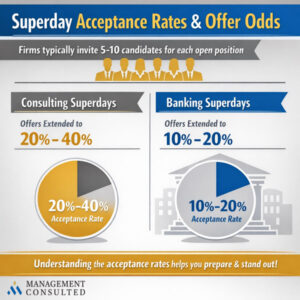
The superday acceptance rate varies widely by firm and role. In general, firms invite 5-10 candidates to a superday for each open position.
Consulting superdays may extend offers to 20%-40% of candidates
Banking superdays often have lower acceptance rates, especially at top-tier firms
Understanding the superday acceptance rate helps set expectations and reinforces why preparation is critical at this stage.
How to Prepare for a Superday Interview
If you’re asking how to prepare for a superday, the answer depends on the industry. Here are the fundamentals for consulting.
Strong superday interview tips include:
Review your resume inside and out to be able to answer the “Walk me through your resume” question
Complete at least 22 cases with an expert interviewer (that’s the average number of cases our successful Black Belt coaching clients complete)
Review your resume inside and out to be able to answer the “Walk me through your resume” question
Prepare 12-15 “hero stories” to answer story-based behavioral interview questions
Expect an “unstructured” case question from a partner
Plan to address the mental fatigue that pops up after multiple interviews
While investment banking superday prep focuses heavily on technical questions, consulting candidates must master structured problem-solving and case interviews.
Consulting Superdays: What to Expect
A consulting superday is case-driven and highly interactive. Unlike finance roles, consulting firms use the superday interview to evaluate how candidates think, communicate, and collaborate.
Consulting Superday Format
Most consulting superdays include:
Two to four case interviews
One or more behavioral or fit interviews
Interviews with consultants, managers, and partners
The superday interview format emphasizes your ability to structure an approach to ambiguous problems, arrive at a reasonable answer under time and data constraints, and communicate under pressure.
Consulting Superday Interview Questions
Common superday interview questions in consulting include:
Behavioral questions (i.e., Walk me through your resume, Why consulting?, Tell me about your greatest strength/weakness/failure, Tell me about a time when…)
Because consulting superdays are case-heavy, your preparation should focus on casing out-loud and with a partner.
Our Black Belt coaching program pairs you with an ex-MBB coach, who will work you through a personalized plan to get ready on an accelerated timeline.
Consulting Superday vs Investment Banking Superday
A consulting superday differs significantly from an investment banking superday:
Consulting superdays emphasize cases and cultural fit
Banking superdays emphasize technical accuracy and stamina
Consulting evaluates business acumen; banking evaluates technical performance
Consulting Firm Superdays by Firm
McKinsey Superday: Consistency, Structure, and Personal Impact Matter Most
A McKinsey Superday (final-round interview day) is one of the most structured and standardized consulting interview experiences. Even at the final stage, McKinsey largely preserves the same interview format as earlier rounds, but with much more senior interviewers and higher expectations.
What the McKinsey Superday Looks Like
Most candidates complete 2-4 interviews in a single day, typically with Engagement Managers, Associate Partners, and Partners. Each interview usually contains two distinct parts:
A case interview
A Personal Experience Interview (PEI)
Unlike some firms, McKinsey does not significantly change the interview format at the Superday stage. Instead, they look for consistency: can you perform at a high level every time, with every interviewer?
How McKinsey Evaluates Candidates
McKinsey’s Superday places heavy emphasis on:
Structured, top-down thinking
Clear hypothesis-driven problem solving
Depth in behavioral answers, especially leadership, conflict, and ownership
Ability to remain composed and logical under pressure
The PEI is not a “soft” component. Interviewers often probe deeply into one or two stories, asking follow-ups until they fully understand your decision-making, actions, and impact.
How to Prepare Differently for McKinsey
For a McKinsey Superday:
Practice clean, repeatable case structure – interviewers expect precision
Prepare two to three PEI stories per theme, knowing you’ll be pushed on details
Focus on clarity and discipline, not creativity for its own sake
Treat every interview as equally important; there is little margin for inconsistency
McKinsey Superdays reward candidates who are reliably excellent, not just strong in flashes.
Bain Superday: Harder Cases and Cultural Fit Come to the Forefront
A Bain Superday is where the firm significantly increases difficulty, both in case complexity and in fit evaluation. Compared to first rounds, Bain final-round interviews are typically more variable and less scripted.
What the Bain Superday looks like
Candidates usually complete 2-4 interviews, often with Senior Managers and Partners. Bain Superday cases tend to be:
More open-ended
Less formulaic
Inspired by real client situations
The structure may vary by interviewer, which means candidates need to be adaptable rather than overly reliant on rigid frameworks.
How Bain Evaluates Candidates
At the Superday stage, Bain focuses on:
Practical business judgment
Comfort with ambiguity
Ability to work collaboratively and communicate naturally
Genuine enthusiasm for Bain’s culture and people
Behavioral and fit questions play a larger role than many candidates expect. Bain interviewers often care deeply about whether they would enjoy working with you on a case team.
How to Prepare Differently for Bain
To succeed in a Bain Superday:
Practice unstructured and creative cases, not just classic frameworks
Be prepared to adjust your approach mid-case
Develop a strong, authentic “Why Bain?” story
Show energy, warmth, and teamwork – not just analytical strength
Bain Superdays favor candidates who feel client-ready, adaptable, and collaborative.
BCG Superday: Candidate-Led Problem Solving and Intellectual Curiosity
A BCG Superday emphasizes ownership of the problem-solving process. Compared to McKinsey and Bain, BCG cases are often more candidate-led, requiring you to actively shape the direction of the interview.
What the BCG Superday Looks Like
Most candidates complete 2-4 interviews in one day with Principals and Partners. Each interview blends:
A case discussion
Behavioral or fit questions
BCG Superday cases are often exploratory, with less guidance from the interviewer. Candidates are expected to propose hypotheses, choose analyses, and explain why they are prioritizing certain paths.
How BCG Evaluates Candidates
BCG interviewers look for:
Strong analytical thinking paired with creativity
Intellectual curiosity and comfort with ambiguity
Clear communication of thought process
Ability to synthesize insights, not just calculate numbers
Fit interviews tend to be conversational but still rigorous, probing how candidates think, learn, and adapt.
How to Prepare Differently for BCG
For a BCG Superday:
Practice leading cases confidently from start to finish
Focus on explaining your reasoning, not just outcomes
Be ready to explore multiple solution paths before converging
Show curiosity and openness when discussing experiences
BCG Superdays reward candidates who can own the problem and guide the conversation, not wait for direction.
MBB Consulting Superdays: Key Differences at a Glance
Other Consulting Superdays
Different firms run consulting superdays slightly differently:
EY superday interviews blend cases and behavioral questions, with more of an emphasis on behavioral questions
FTI Consulting superday interviews are more technically advanced and quant-heavy
Accenture superday interviews require more technology domain expertise
PwC superday interviews focus heavily on fit and communication
Investment Banking Superdays: What to Expect
An investment banking superday interview is more technical and compressed. Candidates should expect rapid-fire interviews with little downtime. Key areas of focus include:
Accounting and valuation questions
Deal walkthroughs
Market and industry knowledge
Strong investment banking superday prep is essential, as investment banking superday questions tend to be unforgiving.
Investment Banking Superdays by Firm
Goldman Sachs Superday: Team Fit and Role Alignment are Evaluated Explicitly
A Goldman Sachs Superday is one of the most structured superday experiences among bulge bracket banks, and it is deliberately designed to assess role fit and team fit, not just raw ability.
What the Goldman Sachs Superday Looks Like
Most Goldman Sachs superdays consist of 2-5 interviews, typically conducted back-to-back on the same day. Candidates often interview with a cross-section of professionals they would realistically work with, rather than a random panel. Depending on the division, interviews may be shorter and more numerous, or fewer but deeper.
For certain roles – especially engineering, operations, and specialized skillset tracks – candidates are often told in advance which teams they are interviewing with. This is intentional: Goldman wants to see whether you understand the team’s function and can clearly articulate why you are a strong match for that specific group.
How Goldman Evaluates Candidates
Goldman’s Superday interviews tend to emphasize:
Structured thinking and clarity (can you explain complex ideas cleanly?)
Motivation that is team-specific, not generic “Goldman prestige” answers
Professional judgment and maturity
Technical competence relative to the role (IB, Markets, Ops, Engineering all differ)
Compared to some peers, Goldman interviewers often probe why you want this exact seat, not just why investment banking or finance broadly.
How to Prepare Differently for Goldman
To prepare effectively for a Goldman Sachs Superday:
Build a tight “Why this team / why this division” narrative
Be ready to connect your experience directly to what that team does day-to-day
Expect fewer “gotcha” technicals and more applied, role-relevant questions
Treat every interviewer as a potential future teammate, not just an evaluator
Goldman’s Superday is less about flash and more about precision and alignment.
A JPMorgan Superday tends to follow a more standardized cadence across many programs, but with greater variation by role than candidates often expect.
What the JPMorgan Superday Looks Like
Many JPMorgan candidates experience a process that looks like:
Initial screen or HireVue
Final-round Superday with ~3 interviews, often a mix of behavioral, technical, and role-specific evaluation
Depending on the program (Investment Banking, Markets, Corporate Banking, Quant, Tech), the Superday may include:
A technical interview
A case, exercise, or presentation
A deep behavioral interview focused on teamwork and judgment
In some programs, candidates receive materials in advance (e.g., a case or prompt) and are expected to discuss or present during the Superday.
How JPMorgan Evaluates Candidates
JPMorgan Superdays are highly role calibrated. Interviewers are often less interested in “finance trivia” and more focused on:
Whether you can perform the actual job
How you think under pressure
Whether you communicate clearly with different seniority levels
Candidates often interview with VPs and Directors, which means answers need to be polished but practical. Review our Pyramid Principle article to understand how executives like to communicate.
How to Prepare Differently for JPMorgan
To succeed in a JPMorgan Superday:
Prepare for role-specific formats, not just generic IB prep
If given prep materials, treat them like a real deliverable: structured, assumption-driven, and defensible
Be ready to explain your reasoning step by step – JPMorgan interviewers often care more about how you think than the final answer (similar to consulting in this manner)
Expect less uniformity than at Goldman; Superdays can feel different across teams
JPMorgan rewards candidates who are operationally ready, not just technically strong.
Morgan Stanley Superday: Polish, Judgment, and Interpersonal Strength Matter Most
A Morgan Stanley Superday is often described by candidates as more behavioral-heavy, with a strong emphasis on professionalism, communication, and fit – especially for client-facing finance roles.
What the Morgan Stanley Superday Looks Like
Morgan Stanley superdays typically include multiple interviews, often with:
A mix of behavioral and technical questions
Interviewers across different seniority levels
Variability by division (IB vs Markets vs Risk vs Tech)
The format can feel less rigid than Goldman’s and less standardized than JPMorgan’s, but expectations around demeanor and communication are extremely high.
Technical competence appropriate to the role (but rarely trivia-heavy)
Even technical answers are evaluated partly on delivery and structure, not just correctness.
How to Prepare Differently for Morgan Stanley
For a Morgan Stanley Superday:
Prioritize clean, concise answers over over-engineering responses
Be crystal clear on why Morgan Stanley specifically
Expect behavioral questions that probe judgment, teamwork, and client interaction
Prepare technicals thoroughly, but don’t neglect communication quality
Morgan Stanley Superdays tend to reward candidates who feel client-ready and composed, not just technically sharp.
Other Investment Banks
Additional banks that run superdays include:
Barclays
BNP Paribas
Deutsche Bank
HSBC
Nomura
Jefferies
UBS
Lazard
Superdays at Asset Managers & Other Firms
Beyond banks and consulting firms, many organizations run superdays:
BlackRock
PIMCO
Citadel
Jane Street
Bloomberg
Capital One
AIG
American Express
Mastercard
Oracle
Optiver
CITGO
How Long Does It Take to Hear Back After a Superday?
Many candidates worry about being ghosted after superday. If there’s no response after superday, it doesn’t always mean rejection.
The typical superday response time ranges from:
24-72 hours for top candidates
1-2 weeks for waitlisted candidates
If you’re wondering how long to hear back after superday, patience is often required – especially at larger consulting firms.
Final Thoughts: Succeeding in Any Superday Interview
A superday is demanding, but reaching this stage means you’re already competitive. Whether you’re preparing for a consulting superday or a banking superday interview, success comes down to preparation, consistency, and stamina.
Working with a coach is the best way to experience what a superday interview is, how firms evaluate candidates, and how to perform with confidence and clarity.
FAQs: Common Superday Questions
Q: I've been ghosted after a Superday. What should I do?
A: Silence after a Superday feels unsettling, especially when you know firms usually move quickly. The good news is that silence rarely means an automatic rejection. It usually reflects internal scheduling, offer-approval delays, or simple bandwidth issues on the recruiting side. Your next steps should be calm, strategic, and respectful of the process.
Give It A Short Window Before Reaching Out
Most firms indicate a timeline at the end of the interview day. If they said “a few days,” wait at least that long. If there was no stated timeline, a four to five business day buffer is reasonable. Recruiting teams often collect feedback from multiple interviewers, compare candidates, and confirm headcount before releasing decisions.
Send A Brief Follow Up To The Recruiter
A concise message works best. Thank them for the opportunity, express your continued interest, and ask if there is any update on your candidacy. This keeps you present in their mind without adding pressure.
Example:
“Hi [Name], I hope your week is going well. I wanted to check in to see if there were any updates on my candidacy following the Superday. I remain very interested in the role and appreciate your time.”
Reach Out Once, Then Stop Do not send multiple follow ups within a short period. One message is enough. Additional messages rarely help and can come across as pushy.
Continue Interviewing Elsewhere
Even strong Superday performers sometimes land on waitlists while firms work through offer pacing. Treat the opportunity as alive but uncertain. Keep moving through other processes so you avoid unnecessary delays in your job search.
Keep Your Confidence Steady
Silence does not signal performance issues. It almost always reflects dynamics inside the firm: shifting headcount, indecision between top candidates, slow interviewer feedback, or budget review.
If You Ultimately Receive No Response
Some firms unfortunately do not close the loop. If a week or two has passed after your follow up with no answer, assume the process is no longer active. Still, maintain professional warmth. Recruiters move between firms and maintain long memories. Stay courteous and keep the door open.
Q: Are Superdays in person?
A: Superdays can be in person or virtual, and the format depends on the firm and the role. Consulting firms, banks, and Fortune 500 strategy teams all handle this a bit differently, but the trend is clear.
Most consulting firms still hold virtual Superdays.
Firms like McKinsey, Bain, and BCG shifted much of their interview process online and have kept that format because it speeds up scheduling and allows interviewers in different offices to participate. University candidates especially see virtual formats.
Some firms choose in person for later rounds.
If a firm strongly values on site culture or team interaction, they may invite finalists to an office for the last round. This is more common in internal strategy teams, boutique consulting firms, and some corporate rotational programs.
Finance roles tend to skew in person.
Investment banking Superdays are often held at the office, as banks prefer to assess presence, communication style, and comfort in a high energy setting.
How to know for sure
Your invitation will specify the format. If it does not, you can ask the recruiter with a simple question:
“Can you confirm whether the Superday will be virtual or on site so I can prepare accordingly?”
Q: How long is a Superday?
A: A Superday usually lasts a half to full day, but the exact length depends on the firm and the number of interviews scheduled.
Here is a clear breakdown of what you can expect:
Typical Consulting Superday Length
Most consulting firms run two to three interviews back to back. Each interview is usually 30 to 45 minutes. With short breaks between sessions, the overall time lands around two to three hours. Some firms add a networking touchpoint or a brief Q and A, which can push it closer to four hours.
Typical Investment Banking Superday Length
Banking Superdays are longer. Candidates often rotate through several teams and meet five to ten interviewers. These days can range from four to six hours, sometimes longer if multiple groups want to meet you.
Corporate Strategy or Rotational Programs
These fall somewhere in the middle at two to four hours, often with a mix of case interviews, behavioral conversations, and a short presentation.
You will know the schedule ahead of time
Recruiters normally send a calendar block with the full length or a sequence of meeting invites so you can plan your day.
Q: What is a Superday interview?
A: A Superday interview is a final round event where a candidate completes several back to back interviews with different team members in one block of time. Firms use it to assess problem solving, communication, and overall fit before making hiring decisions.
Q: How long to hear back after Superday?
A: Most firms share decisions within a few days of the Superday, and many respond in one to three business days. Some teams take a bit longer if they are finalizing headcount or comparing top candidates, or you've been waitlisted. So a response up to two weeks is still normal for those who have been waitlisted.