Understand The Watson Glaser Test: Learn how this critical thinking assessment evaluates logic, reasoning, and argument strength.
Master Each Section: Build precision through practice in inference, assumptions, deduction, interpretation, and argument evaluation.
Develop a Proven Strategy: Use structured preparation and examples to boost accuracy, confidence, and overall Watson Glaser test performance.
The Watson Glaser test shows up in many competitive recruiting funnels, especially in law, because firms need a fast, fair way to screen for critical thinking. If you plan to pursue a training contract, a vacation scheme, or a role that prizes structured reasoning, the Watson Glaser test will likely be part of your path. Treat it like a case interview for your thinking. You are being assessed on clarity, logic, and discipline under time pressure, not on outside knowledge.
What Is The Watson Glaser Test
The Watson Glaser test, created by Goodwin Watson and Edward Glaser, measures your ability to interpret information, spot assumptions, draw valid conclusions, and evaluate argument strength. It is an aptitude assessment of critical thinking. In practice, the Watson Glaser test asks you to set aside intuition, read short passages with care, and apply strict rules to judge what follows and what does not. Success on the Watson Glaser test comes from methodical reasoning, not clever guesses.
Who Uses The Watson Glaser Test
Law firms, government agencies, and other employers use the Watson Glaser test because critical thinking predicts success in roles that require crisp judgment and persuasive communication. When hundreds of applicants target a few spots, the Watson Glaser test helps produce a shortlist. Top consulting law firms could use this assessment. For you, that means the Watson Glaser test is both a hurdle and an opportunity. Strong performance can quickly differentiate you in a crowded field, as many do poorly on the test.
Inside The Watson Glaser Test Structure
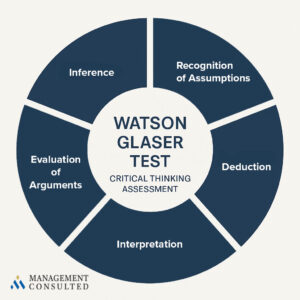
The Watson Glaser test typically includes 40 questions split into five sections, each probing a different facet of reasoning. Inference asks you to decide if statements are true, probably true, insufficient, probably false, or false given a short prompt. Recognition of assumptions checks whether an argument quietly relies on unstated premises. Deduction tests whether a conclusion necessarily follows from given rules. Interpretation asks whether a conclusion follows from a passage you must take as true. Evaluation of arguments judges whether reasoning is strong or weak. Knowing these five parts is non-negotiable for the Watson Glaser test.
Timing, Scoring, And What A Competitive Watson Glaser Test Score Looks Like
Depending on the version, you may receive 30 to 60 minutes for the Watson Glaser test. Scores are often normed, which means your raw correct answers convert to a percentile. Many legal employers view top quartile or top decile performance as competitive. A practical target for the Watson Glaser test is 75 to 80 percent correct or higher, recognizing that each firm sets its own benchmarks and uses scores alongside broader application signals.
The Rules That Make The Watson Glaser Test Feel Different
Two features of the Watson Glaser test surprise candidates. First, you must ignore outside knowledge and personal beliefs. If a passage says the sky is green, then in that world the sky is green. Second, answer options like probably true and probably false demand calibrated judgments, not absolute calls. The Watson Glaser test rewards letting go of intuition and following consistent algorithms. Read precisely, separate facts from assumptions, and apply the test’s rules with discipline.
Preparing For The Watson Glaser Test
Preparing for the Watson Glaser test is not about memorizing facts or revising subject knowledge. It is about learning a specific way of thinking, akin to the consulting case interview. Because each section of the Watson Glaser test measures a different component of critical reasoning, the best preparation strategy focuses on mastering the logic, format, and pace of each question type.
Be prepared to address the 5 sections of the test:
Inference Section
Goal: Determine whether an inference logically follows from the facts provided.
Approach: Read the statement as absolute truth. Then evaluate each inference only against the facts stated. Label each inference as true, probably true, insufficient data, probably false, or false.
Preparation Tip: Train by reading short news paragraphs and practicing labeling possible conclusions. The skill is to suspend your personal knowledge and rely purely on the text.
Recognition Of Assumptions Section
Goal: Identify whether an argument depends on an unstated belief.
Approach: After reading the argument, ask yourself, “What must be true for this argument to work?” If the answer introduces new information not clearly stated, an assumption has been made.
Preparation Tip: Practice the “negative test.” Reverse the assumption and check if the argument collapses. If it does, you have identified an assumption.
Deduction Section
Goal: Decide whether a conclusion follows logically and necessarily from the statements given.
Approach: Treat every statement as a logical rule. Draw simple diagrams or letter symbols (A→B, B→C) to test if the conclusion must be true. If it is only possible but not guaranteed, select “does not follow.”
Preparation Tip: Use syllogism exercises to train yourself to spot hidden logical gaps quickly.
Interpretation Section
Goal: Evaluate whether a conclusion follows from a short passage.
Approach: Assume all statements in the passage are true and complete. Check whether the conclusion extends beyond the text or introduces new assumptions. If it does, it does not follow.
Preparation Tip: Practice concise reading. Focus on one sentence at a time, underlining logical connectors like “therefore,” “since,” and “because.”
Evaluation Of Arguments Section
Goal: Judge the strength of arguments based on relevance and logical support.
Approach: A strong argument directly addresses the question, is factually relevant, and is based on reasoning rather than emotion. Weak arguments are off-topic, subjective, or exaggerated.
Preparation Tip: Rank practice arguments by strength and explain why. The reasoning process matters more than the final label of strong or weak.
Examples And Quick Tactics For The Watson Glaser Test
Small examples can help you see exactly how to move from confusion to clarity in the Watson Glaser test. Each scenario below walks through a real reasoning pattern, showing the “why” behind the correct answer and the precise steps to reach it.
Example 1: Deduction – Testing Logical Necessity
Scenario: All cats are mammals. Some mammals are black. Therefore, some cats are black.
Why It Matters: Many candidates confuse possibility with necessity.
How To Solve:
Write the statements symbolically: All C are M; Some M are B.
The overlap between C and B is not guaranteed. Some mammals could be black without any being cats.
Therefore, the conclusion does not follow.
Takeaway: In deduction questions, if something could be true but is not necessarily true, the correct answer is “does not follow.”
Example 2: Inference – Anchoring To Text Only
Scenario: The passage says: “A company fined two employees $500 each for breaching safety rules.”
Inference: The company lost at least $1,000 due to safety violations.
Why It Matters: Candidates often inject outside interpretation, such as assuming financial loss.
How To Solve:
Identify what is stated: the company issued fines, not that it lost money.
The inference uses outside assumptions about financial loss.
Label as “probably false.”
Takeaway: Never bring external logic into the Watson Glaser test. Only evaluate what the passage provides.
Example 3: Assumptions – Applying The Negative Test
Scenario: Statement: “We need to save time getting there, so we should take the train.”
Assumption: Taking the train will be faster than other transport.
Why It Matters: This reveals how hidden beliefs support reasoning.
How To Solve:
Ask what must be true for the conclusion to make sense.
If the train were not faster, the statement collapses.
Therefore, the assumption is made.
Takeaway: Always ask “What if this assumption were false?” If the argument breaks, it is an assumption.
Example 4: Interpretation – Testing Logical Scope
Scenario: Passage: “Eighty percent of graduates from City University found employment within six months.”
Conclusion: City University guarantees employment for its graduates.
Why It Matters: Candidates overextend the text’s meaning.
How To Solve:
Check what is literally stated: 80% found jobs, not 100%.
The conclusion introduces “guarantees,” which is new information.
Therefore, the conclusion does not follow.
Takeaway: The Watson Glaser test rewards restraint. Follow what the passage confirms, not what it implies.
Example 5: Evaluation – Judging Argument Strength
Scenario: Question: “Should companies offer remote work options?”
Argument: “Yes, because remote work reduces office space costs and can boost productivity.”
Why It Matters: Candidates must weigh relevance and factual grounding.
How To Solve:
Check relevance: the argument directly supports the question.
Check logic: reduced costs and higher productivity are measurable outcomes.
Label it “strong argument.”
Takeaway: Strong arguments in the Watson Glaser test connect cause and effect clearly and stay focused on the question.
Drawbacks And Challenges Reported About The Watson Glaser Test
Not every recruiter swears by the Watson Glaser test. Some hiring teams report high fail rates and candidate drop off when the Watson Glaser test appears early in the funnel. Others say they struggled to link high scores to on the job performance after a year in role and eventually reduced or removed the assessment. Practitioners also note that the Watson Glaser test can feel learnable rather than purely diagnostic, which disadvantages those who do not practice its unique format. The practical takeaway is twofold. First, you should expect that the Watson Glaser test rewards targeted preparation. Second, do not assume the test alone defines your candidacy. It is one input among many, and some employers are reconsidering how heavily to weigh the Watson Glaser test in their decisions.
Common Mistakes On The Watson Glaser Test And How To Avoid Them
The first mistake is importing outside knowledge into the Watson Glaser test. If it is not in the passage or in the rules, it does not count. The fix is to underline controlling phrases and treat the passage as a sealed system. The second mistake is speed without structure. Rushing leads to small logic slips that compound. The fix is to use quick checklists for each section of the Watson Glaser test, even under time pressure. The third mistake is treating probably true or probably false as gut calls. The fix is to define a threshold, for example, more likely than not given only the text, and apply it consistently on the Watson Glaser test.
Final 7 Day Plan To Prepare For The Watson Glaser Test
Day 1: Take a timed diagnostic Watson Glaser test, tag errors by section and by cause. Day 2: Build algorithms for inference and assumptions, then run two timed blocks. Day 3: Build algorithms for deduction and interpretation, then run two timed blocks. Day 4: Build an evaluation rubric, then complete a mixed set for the Watson Glaser test. Day 5: Full timed Watson Glaser test, 40 items. Deep review, write one line fixes per error type. Day 6: Mixed speed rounds, 10 to 12 items per section with strict pacing. Day 7: Final full Watson Glaser test simulation, then light review and rest.
Follow this plan, and you will enter the Watson Glaser test with clear routines, calibrated timing, and confidence. The assessment rewards calm, precise thinkers who can separate what is stated from what is merely assumed. Treat it as a skill you can train, and the Watson Glaser test becomes another chance to demonstrate the judgment employers want.
If you want professional help with structured thinking, check out our interview coaches.
Conclusion
The Watson Glaser test is not a measure of intelligence, but a disciplined test of reasoning. It challenges you to think precisely, question assumptions, and apply logic under time pressure. For aspiring lawyers and professionals in analytical roles, mastering this test demonstrates the ability to build arguments based on evidence, not instinct.
With consistent practice and familiarity with its structure, you can turn what feels like an abstract assessment into a clear, repeatable process. Learn the logic behind each section, simulate real timing, and focus on accuracy over intuition. Treat every question as a small puzzle: isolate facts, reject outside knowledge, and reason to the conclusion that must be true.
Approach the Watson Glaser test not as an obstacle, but as a professional skill to refine. The habits it builds—structured thinking, attention to detail, and logical communication—are exactly the qualities top employers look for long after the test is over.