Customer Experience (CX): The Key to Building Lasting Business Success
Estimated Reading Time: 8 minutes
Key Insights:
Customer Experience (CX) Drives Growth: A seamless, empathetic journey increases loyalty and revenue.
Technology Enhances CX: AI, automation, and data insight personalize service at scale.
CXM Creates Consistency: Managing CX strategically turns great experiences into a repeatable competitive advantage.
Customer experience (CX) is now the defining battleground for competitive advantage. Product quality and pricing still matter, but how customers feel throughout their journey increasingly determines whether they stay loyal or switch brands. From discovery to post-purchase engagement, CX influences every interaction.
As Gartner reports, “89% of companies surveyed consider customer experience to be the new competitive battlefield.” The message is clear: organizations that prioritize CX outperform those that don’t. Companies that deliver seamless, personalized, and human-centered interactions win lasting loyalty and long-term growth.
Understanding What Customer Experience (CX) Really Means
Customer experience (CX) encompasses the total impression a customer has of a company based on all interactions, both online and offline. It’s not limited to customer service—it’s the entire journey.
A strong CX ensures customers feel valued, understood, and supported. It requires empathy-driven design and anticipation of customer needs. For example, an intuitive website, proactive communication, and frictionless checkout all contribute to excellent CX.
Jeff Bezos captured it best:
“We see our customers as invited guests to a party. And we are the hosts. It’s our job every day to make every important aspect of the customer experience a little bit better.”
That mindset drives the world’s top brands to continually refine every detail of their customer journey.
The Business Impact of a Strong Customer Experience (CX)
The link between customer experience (CX) and financial performance is undeniable. Studies consistently show that companies leading in CX generate higher revenues, stronger retention, and lower acquisition costs. A positive CX builds trust and loyalty, leading customers to return, repurchase, and refer others.
By contrast, poor CX creates friction that drives customers away, often to competitors that better anticipate their needs. A single bad interaction can undo years of brand equity.
How Does Customer Experience (CX) Impact Sales?
Customer experience (CX) directly affects conversion and revenue. When customers find a process simple, pleasant, and trustworthy, they buy faster and spend more. CX reduces sales resistance by building confidence.
In B2C, great CX increases basket size and repeat purchases. In B2B, it strengthens long-term partnerships and contract renewals. The emotional component is key: when customers enjoy doing business with you, price sensitivity drops and brand advocacy rises.
Customer Experience (CX) vs. Customer Service
Customer service is one part of the broader customer experience (CX). Service responds to customer issues; CX prevents those issues in the first place.
For example, customer service handles a late shipment; CX ensures proactive communication before delays occur. Customer service solves problems; CX designs systems that make problems rare.
The best organizations integrate both, using feedback from service teams to continuously improve the total experience.
Key Components of an Exceptional Customer Experience (CX)
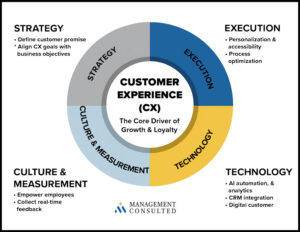
A world-class customer experience (CX) rests on four foundational pillars:
Consistency: Every interaction reflects your brand promise. Customers should experience the same quality whether online, in person, or through a support channel.
Personalization: Use customer data responsibly to deliver relevance. Personalized recommendations, follow-ups, and tone make customers feel seen.
Accessibility: Ensure ease of access across platforms, devices, and demographics. CX should be inclusive and intuitive.
Emotional Connection: The most memorable experiences touch emotion—trust, delight, security, or belonging.
When these elements align, brands transform one-time buyers into lifelong advocates.
Strategies to Improve Customer Experience (CX) in Any Industry
Improving customer experience (CX) requires curiosity and continuous learning. Start by mapping the entire customer journey, from first awareness to post-purchase loyalty. Identify friction points, gather feedback, and empower employees to fix issues proactively.
CX improvement should be iterative, not occasional. The best companies build listening loops where insights from customers drive action.
What Does Good Customer Experience (CX) Look Like?
Good CX feels effortless. Customers can find what they need, understand their options, and complete goals quickly. Think of Apple, where simplicity defines every touchpoint. Clean design, intuitive navigation, and proactive support create confidence and enjoyment.
In professional services, good CX might look like transparent communication, clear timelines, and personalized advice that makes the client feel like a partner, not a transaction.
What Does Bad Customer Experience (CX) Look Like?
Bad CX frustrates or confuses. Long wait times, inconsistent messaging, hidden fees, or difficult navigation all signal neglect. Customers leave such interactions feeling ignored. We've all experience this, and it leaves us frustrated.
In a hyperconnected world, one bad experience can go viral overnight. Poor CX erodes brand equity faster than almost any other business failure.
Leveraging Technology to Enhance Customer Experience (CX)
Technology, when used thoughtfully, can elevate customer experience (CX) by improving speed, personalization, and consistency. Artificial intelligence, automation, and analytics allow businesses to tailor services at scale.
AI chatbots can resolve basic issues instantly. Predictive analytics can identify customer needs before they arise. CRM systems create a unified view of each customer across sales, marketing, and support. But technology still has it's limitations, and a human should be available to step in when the AI or technology fails.
How to Improve CX
To strengthen CX through technology:
Integrate systems across channels for seamless transitions.
Use automation to remove repetitive tasks, freeing humans for higher-touch moments.
Employ predictive analytics to anticipate customer needs.
Ensure transparency, customers should always know how their data is used.
Maintain humanity: technology should enhance, not replace, empathy.
When done right, technology makes CX faster, smarter, and more human.
Measuring Customer Experience (CX) Effectively
Measurement converts CX from a concept into an actionable business strategy. Without metrics, improvements rely on guesswork.
The most successful companies use a combination of quantitative and qualitative measures to assess customer sentiment and loyalty.
Customer Experience (CX) KPIs
Top CX metrics include:
Net Promoter Score (NPS): Gauges likelihood of recommending your brand.
Customer Satisfaction (CSAT): Measures satisfaction after specific interactions.
Customer Effort Score (CES): Evaluates how easy it is to complete a task.
Customer Retention Rate: Tracks how many customers continue doing business with you.
Lifetime Value (LTV): Estimates long-term financial contribution per customer.
Beyond numbers, interviews, reviews, and social sentiment reveal context that data alone can’t.
Building a Customer-Centric Culture
True customer experience (CX) excellence begins with internal culture. Every employee, whether in operations, finance, or HR—shapes the customer journey.
Leadership must champion CX values, model empathy, and empower staff to act in the customer’s best interest. Recognition programs that celebrate CX wins can reinforce this mindset.
Generational Differences On Good CX
Customer expectations vary by generation:
Baby Boomers: Prioritize reliability, politeness, and phone-based support.
Gen X: Values efficiency and straightforward communication.
Millennials: Expect personalization, transparency, and social responsibility.
Gen Z: Demands instant responses, digital convenience, and authenticity.
Tailoring CX strategies by demographic ensures each group feels understood and valued.
Customer Experience Management (CXM)
Customer experience management (CXM) is the structured approach to designing, tracking, and improving all customer interactions. CXM integrates people, processes, and technology into a unified system focused on delivering consistent excellence.
Effective CXM combines data analytics, customer feedback, and operational alignment. It identifies where friction occurs and ensures accountability for resolution. CXM tools aggregate feedback across channels, allowing leaders to prioritize improvements with measurable ROI.
In short, CXM turns CX from philosophy into disciplined execution.
Conclusion
Customer experience (CX) is the heartbeat of modern business success. It shapes brand reputation, drives retention, and fuels profitability. Companies that elevate CX gain something competitors can’t easily copy: deep emotional connection.
As industries evolve, customer expectations will only rise. The organizations that thrive will be those that integrate CX into their DNA—listening, adapting, and consistently delivering value.
Frequently Asked Questions
Q: What is customer experience management (CXM)?
A: CXM is the practice of collecting, analyzing, and improving customer interactions across every channel. It aligns people, data, and processes to ensure customers receive consistent, personalized, and high-quality experiences.
Q: What are some future CX trends?
A: Expect to see growth in AI-powered personalization, predictive analytics, self-service tools, and immersive technologies like AR and VR. Emotional AI and ethical data practices will also define the next frontier of CX.
Q: What are the 5 C’s of customer experience (CX)?
A: The 5 C’s are Culture, Consistency, Communication, Convenience, and Care. These pillars guide brands toward sustainable CX excellence.
Q: What is digital customer experience (DCX)?
A: Digital customer experience (DCX) refers to how customers interact with a brand online—through websites, apps, chatbots, and social media. It’s a critical part of overall CX strategy.
Q: What are some companies with the best customer experience (CX)?
A: Amazon, Apple, Zappos, and Ritz-Carlton lead global CX rankings. Each combines technology, empathy, and proactive design to deliver memorable experiences.
Q: What are customer journeys?
A: Customer journeys map every step of a customer’s interaction with a brand—from awareness to advocacy—helping identify opportunities for improvement.
Q: Is customer experience (CX) the same in B2B and B2C?
A: Not exactly. B2C CX focuses on speed, emotion, and convenience, while B2B CX emphasizes trust, expertise, and relationship depth.
Q: What are the differences between customer experience (CX) and employee experience (EX)?
A: CX measures how customers perceive your brand; EX evaluates how employees feel about their work environment. Strong EX fuels better CX—engaged employees deliver exceptional service.